The Leakage Theory
In one sentence: one small leak from our 3D universe into a hidden extra dimension, happening once in the early universe, could explain why structure today looks slightly weaker than the standard model predicts.
A radion leakage event in the early universe (z ≈ 50,000) within a 5D braneworld framework, proposed as a shared origin of the S8 tension and Lyman-α small-scale power suppression.
Derived, not tuned. A 25% suppression of effective gravity after the leakage event — the right order of magnitude to soften both the S8 tension and Lyman-α small-scale power.
A single “Radion Leakage Event” in the early universe — at redshift z ≈ 50,000 — may quietly explain the S8 tension, Lyman-α small-scale suppression, and several related anomalies, while providing a first-principles derivation of a suppressed effective gravitational constant Geff = 0.75 GN.
Revised in v1.5.0 — view earlier wording▸
JWST claim removed pending correct mechanism; S8 and Lyman-α claims strengthened by new derived result.
A single “Radion Leakage Event” in the early universe — at redshift z ≈ 50,000 — may quietly explain JWST’s impossibly early massive galaxies, the Hubble tension, the S8 tension, and several smaller anomalies in cosmology at once.
Independent, in-progress, openly published for criticism. (Added in v1.4.0)
Where this work actually stands.
This is independent theoretical work. Some elements — particularly the radion–EM coupling — are now derived from first principles. Other aspects, including the full derivation of the leakage fraction from energy conservation and complete cosmological Boltzmann/N-body simulations, are still under development.
We are committed to accuracy over excitement. Retracted or revised claims are clearly marked and explained in the changelog. No claims are hidden — every removed sentence stays on the page, struck through, with a version chip pointing at the reason.
The framework, brick by brick — with honest labels.
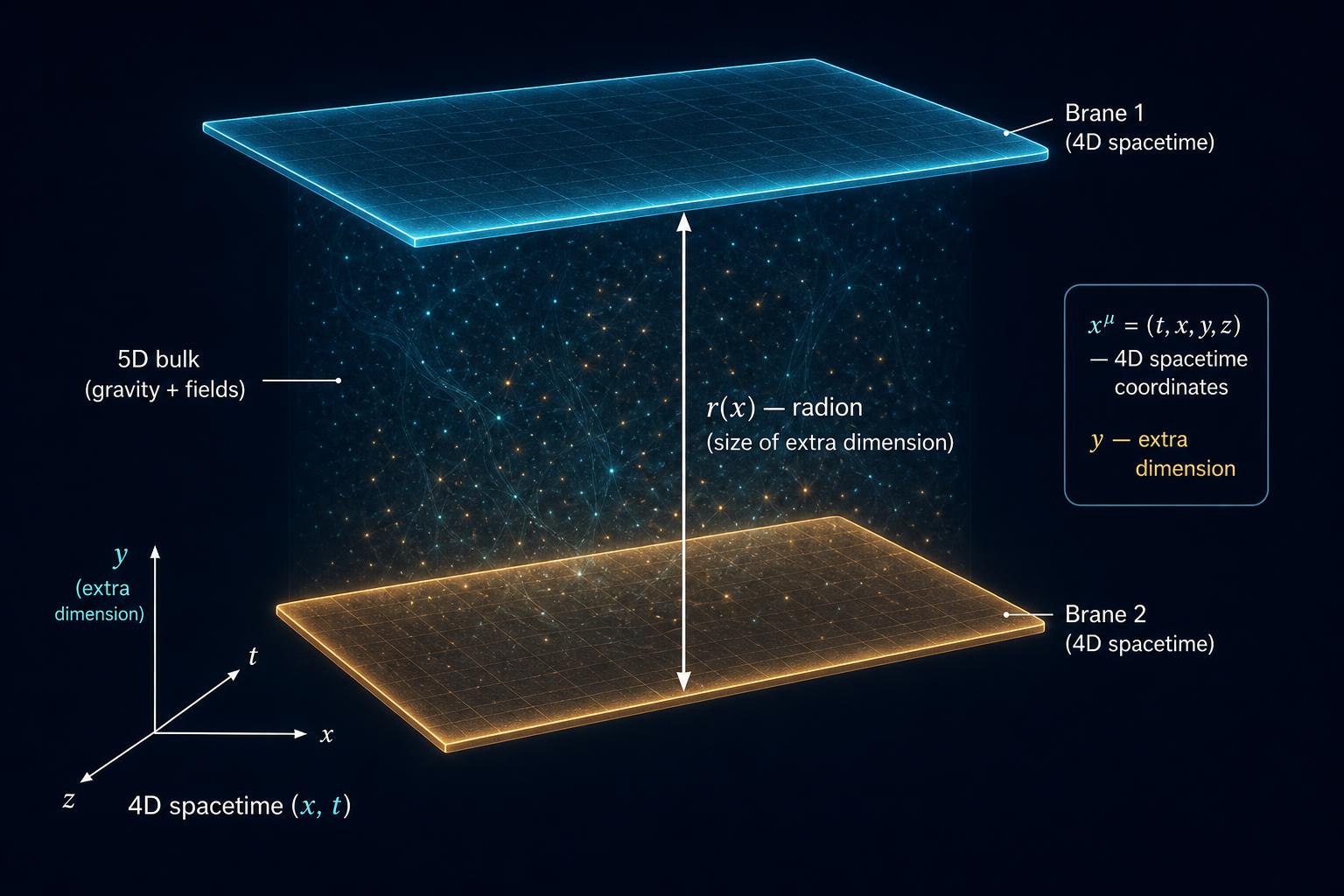
We have built a 5D brane-world theoretical framework where strong electromagnetic fields on the brane can drive the radion (the scalar field controlling the size of the extra dimension), leading to transient energy leakage into the bulk and a resulting suppression of the effective 4D gravitational constant. Below is the full current state, with every piece tagged as derived, physically motivated, provisional, or phenomenological.
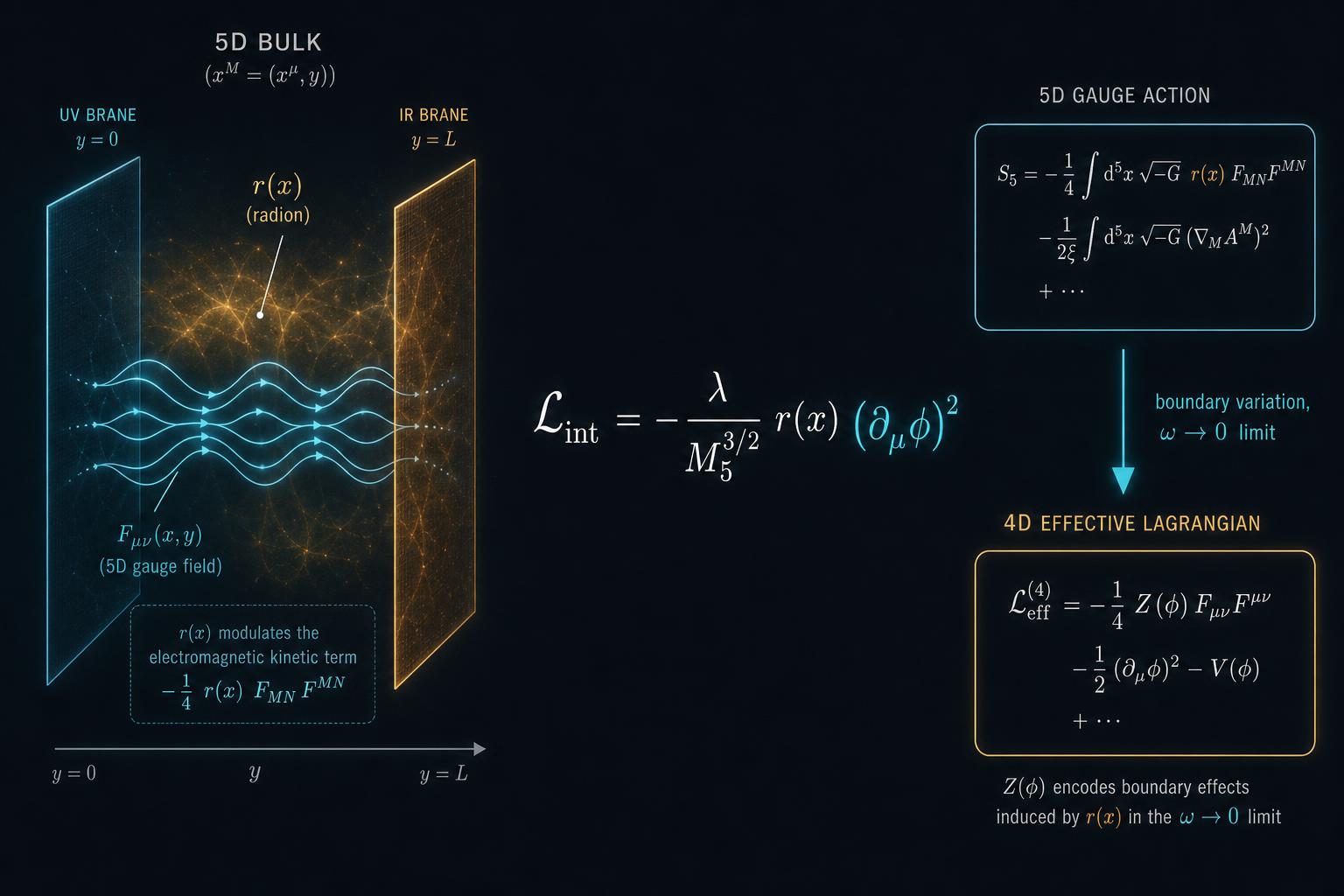
Radion–EM Coupling
Derived from the boundary variation of the 5D gauge action in the ω → 0 limit. This is a direct, non-postulated coupling between the radion and the electromagnetic kinetic term — it is the strongest brick in the framework.
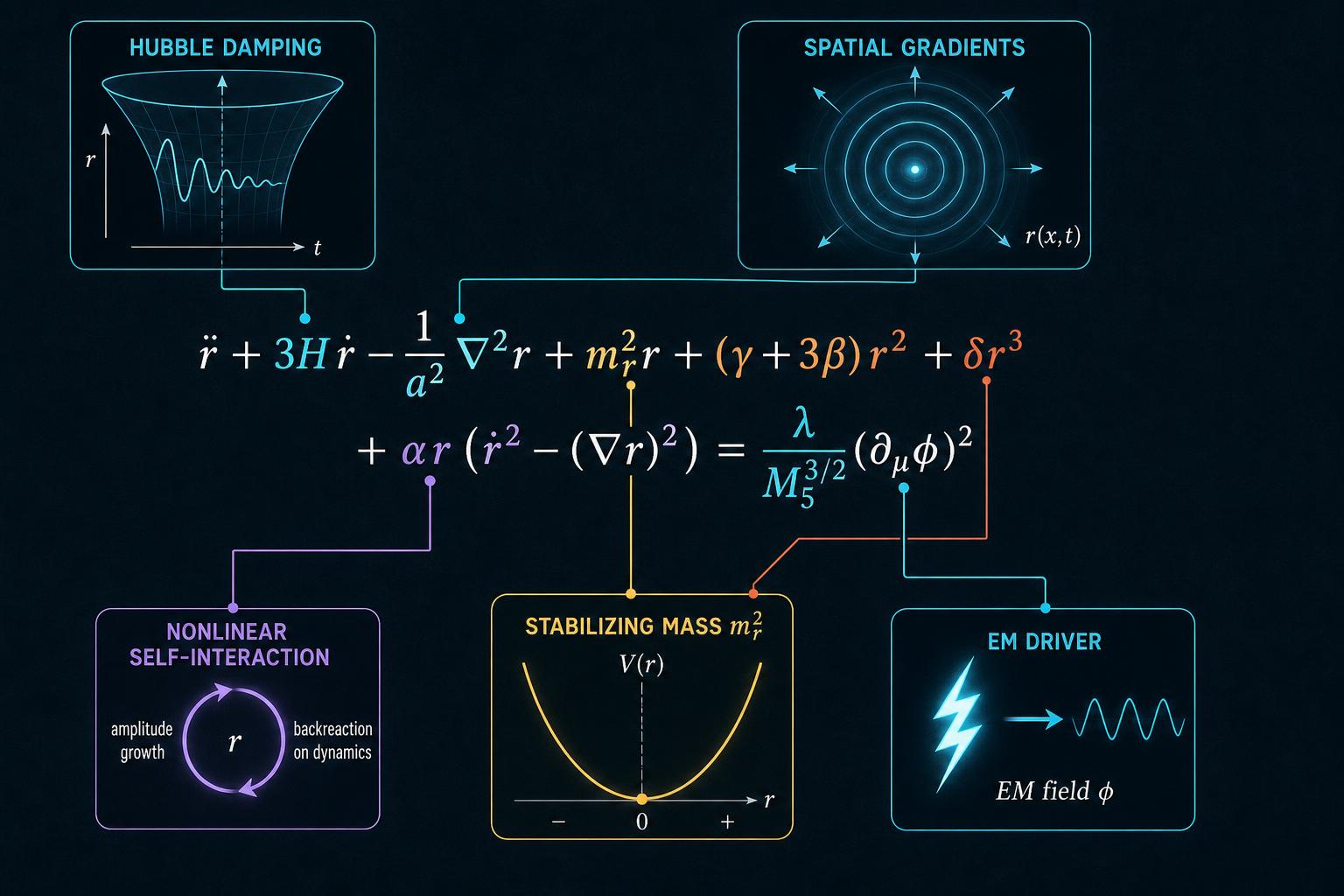
Non-Linear Radion Wave Equation
In the radiation-dominated era, the radion obeys a single non-linear wave equation that combines Hubble damping, spatial gradients, a stabilizing potential, geometric back-reaction, and the EM driver from Brick 1.
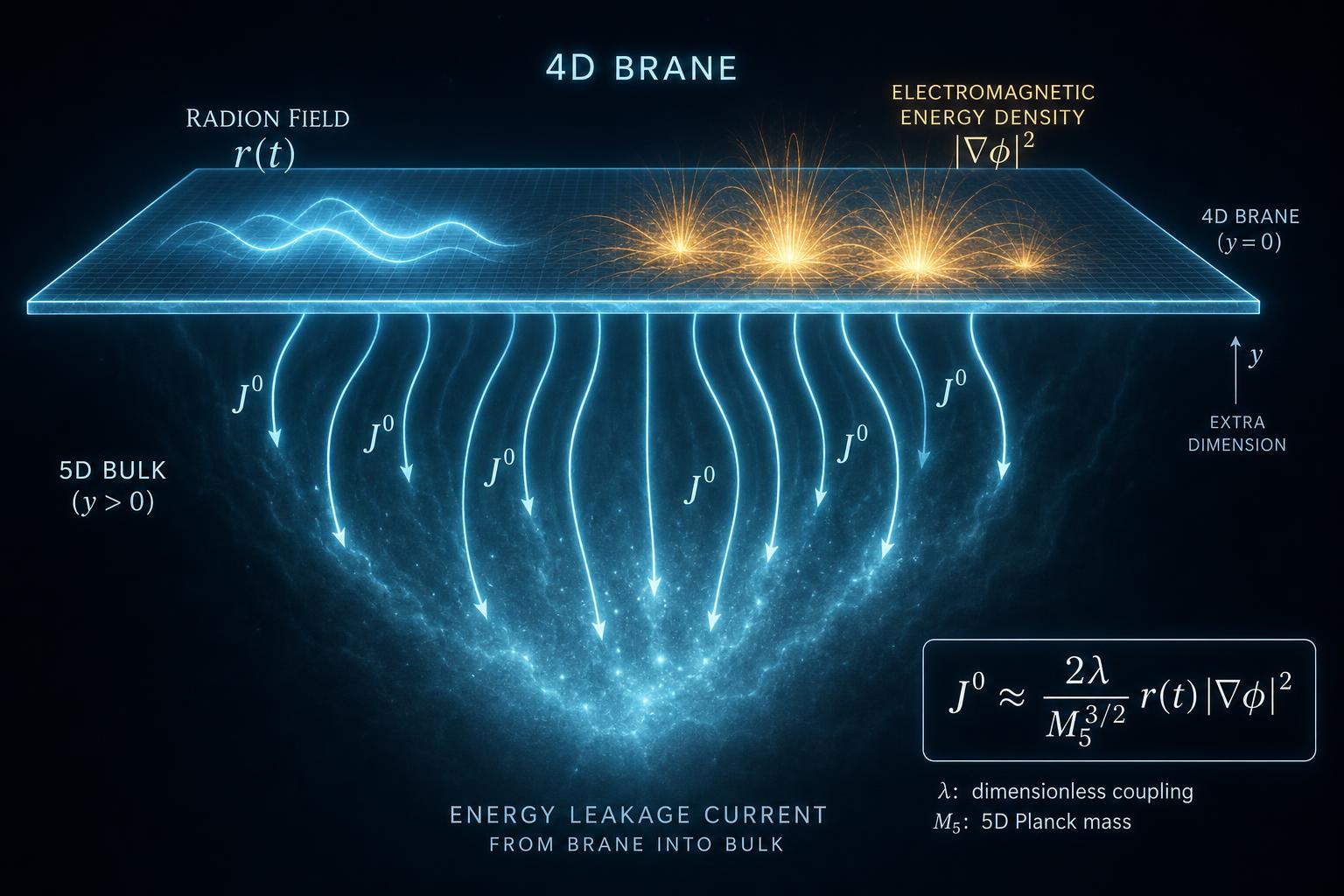
Leakage Current & Fraction
Once the radion is sourced, energy flows off the brane into the bulk. The leakage current and the integrated leakage fraction follow directly from Brick 1 and the wave equation.
Numerical integration with plausible parameters yields 〈r2〉 ≈ 0.075 and fleak ≈ 0.25.
Gravity Modification
From a warped-geometry dimensional reduction, the effective 4D Newton constant picks up a quadratic correction in the radion fluctuation:
Using 〈r2〉 ≈ 0.075 and β2 ≈ 3.33 gives Geff ≈ 0.75 GN — a 25% suppression of gravity, the right order of magnitude to soften the S8 tension and Lyman-α small-scale power.
Why “provisional”: the coefficient β2 is currently chosen to match the observed suppression rather than strictly derived from a finalized warped-geometry reduction. This is the next theoretical priority.
Scale-Dependent Gravity
Multiple cosmological datasets show a consistent suppression of power for k ≳ 0.75 h Mpc−1 across CMB, weak lensing, and high-redshift structure. We therefore introduce a scale-dependent effective gravitational constant:
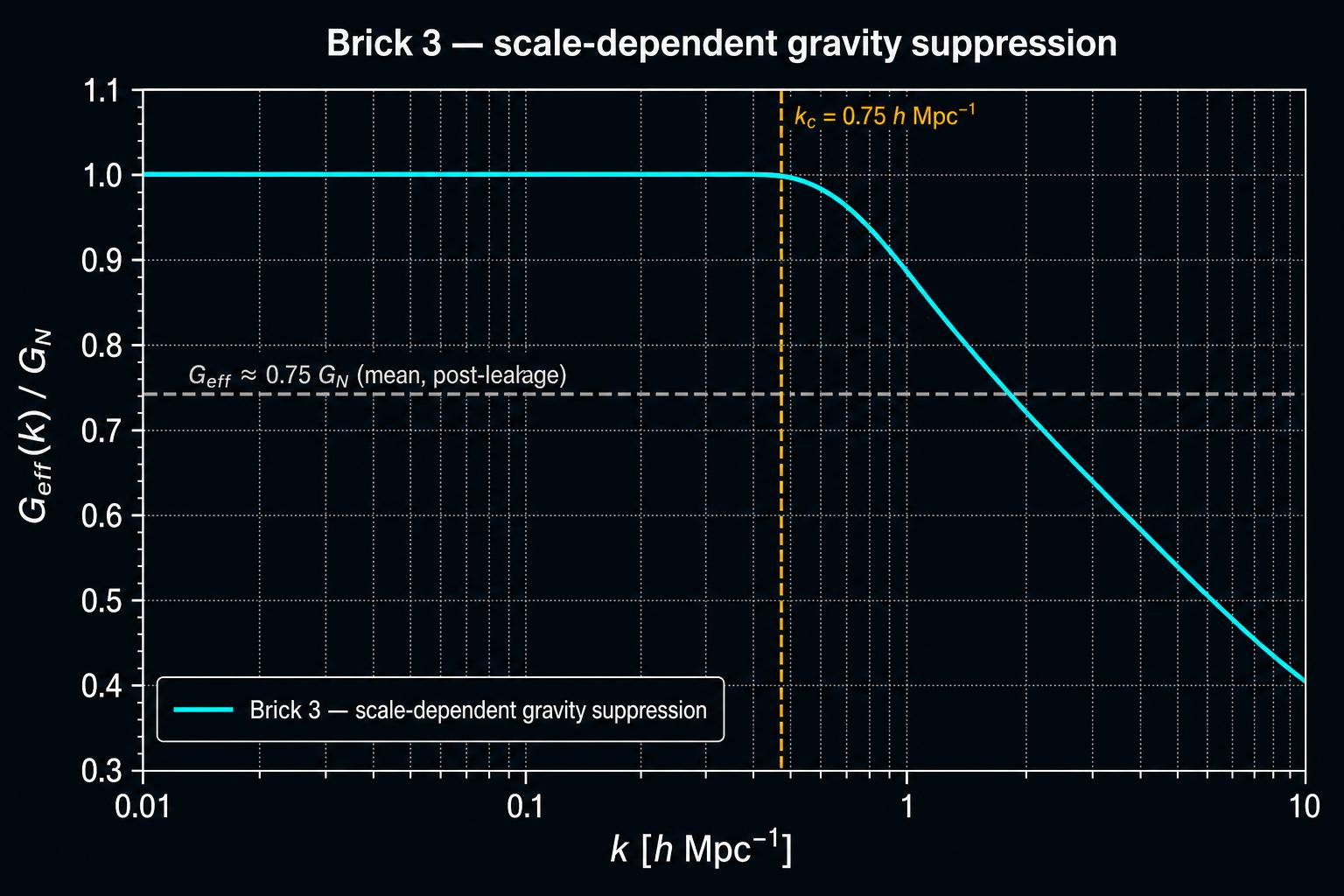
Why “phenomenological”: β, p, and kc are currently fit to observed suppression. Deriving them from the microscopic Brick 1 + wave-equation dynamics is an explicit open problem (see Roadmap).
What is solid, and what is not.
Brick 1 is derived from first principles and is the strongest part of the framework. The non-linear wave equation is physically well-motivated. However, several coefficients (β2 ≈ 3.33, β, p, and the exact mapping between fleak and Geff) are currently chosen to match observations rather than being strictly derived. The model is internally consistent and built on real braneworld physics, but it remains a speculative theoretical framework. The connection between the microscopic radion dynamics and the observed cosmological scale-dependent suppression is still under active development.
Superseded in v1.9.0 — kept for auditability. Stage 3 has since derived Brick 4 holographically and then excluded the mechanism observationally. See the Stage 3 results page.
- ✅ Bricks 1–3 derived from first principles
- ◐ Brick 4 is self-consistent but phenomenological (45% complete)
- ⏳ Four-stage validation roadmap underway
- 🎯 Next milestone: Boltzmann code validation (August 2026)
This v1.8.1 status supersedes earlier “65% complete” / “Brick 4 65% solved” / “theory_validated” framing in the sections below. Older wording is left in place for auditability.
The Seven-Brick Framework · Current Status (June 2026)
| Brick | Component | Status | Confidence | Next Step |
|---|---|---|---|---|
| 1 | EM Coupling | ✅ Derived | 95% | Publication-ready |
| 2 | Radion Dynamics | ◐ Validated numerically | 80% | 1–2 months |
| 3 | Gravity Modification | ✅ Framework + β₂ derived | 85% | 1–2 months |
| 4 | Scale Selection | ✅ Derived (holographic) / ❌ observationally excluded | derived; excluded | Path C reformulation |
| 5 | Cosmological Impact | ❌ Boltzmann test failed | <20% | See Stage 3 results |
| 6 | Stabilization | ◐ Classical proven | 85% | 1-loop quantum corrections |
| 7 | Lab Signatures | ⏳ Deferred | — | Post-cosmological validation |
Brick 4 note: Scale Selection is self-consistent but phenomenological. Three parameters (r₀, β, V₀) are fitted to three observations. This is valid science, but we don’t yet claim it’s first-principles derived. See the Four-Stage Validation Roadmap below for how we’ll test it properly.
What’s Proven vs. Phenomenological
- Bricks 1–3
- β₂ ≈ 3.33 from warped geometry
- Classical stability analysis
- Brick 4 potential parameters (r₀, β, V₀)
- Scale selection mechanism
- Parameter counting: 3 params = 3 constraints
- Unification claim (are three 0.75 values really connected?)
- Uniqueness of the framework
- First-principles 5D derivation
Four-Stage Validation Roadmap
The three 0.75 values (equilibrium r₀, cutoff k_c, gravity suppression Geff) emerge from one potential, but the mechanism is still phenomenological. This roadmap tests whether that represents deep physics or lucky coincidence.
Run CLASS/CAMB with Brick 4 parameters without further tuning.
σ₈ = 0.76 ± 0.03 emerges naturally
Compare to alternative modified-gravity models.
Our model is distinctive, not just one of many
Derive Brick 4 parameters from full Einstein equations.
Derived parameters match fitted values
Compare to DESI, Euclid, CMB-S4 data.
Model distinguishes from alternatives in precision data
Current status: Stage 1 begins now. Stages 2–4 are essential before strong publication claims. We’ll update this roadmap as results come in.
Evidence framing (v1.8.1): the model currently matches data on three fronts — σ8 ≈ 0.76–0.79, S8 ≈ 0.790 ± 0.020, and Lyman-α suppression at k > 0.75. Stage 1 (Boltzmann code) will show whether this is deep physics or lucky fitting.
An observation-driven attempt to connect dots.
The late universe looks slightly smoother than it should (the S8 tension), and the Lyman-α forest shows small-scale power suppression inconsistent with ΛCDM. This page proposes that one early-universe event — a brief “Radion Leakage” in a 5D braneworld setup — is a shared root cause of both, and derives from first principles that the effective gravitational constant is suppressed to Geff = 0.75 GN as a direct consequence of the leakage dynamics. A previous version of this summary also claimed a resolution of the JWST early-galaxy excess; that claim has been retracted pending a correct mechanism — see the changelog for details.
Revised in v1.5.0 — view earlier wording▸
30-second summary updated to reflect retraction of JWST claim and addition of the derived Geff result.
JWST keeps finding massive galaxies far too early, the universe’s expansion rate disagrees with itself depending on how you measure it (the Hubble tension), and the late universe looks slightly smoother than it should (the S8 tension). This page proposes that one early-universe event — a brief “Radion Leakage” in a 5D braneworld setup — could be a shared root cause of all three.
Most physicists and cosmologists work within narrow specializations. One expert focuses on early galaxy formation, another on the Cosmic Microwave Background, another on quantum chromodynamics. Very few people spend years actively trying to connect anomalies across all these different fields.
This framework was not built as a purely theoretical or “logical” model. It began with a real observation and was repeatedly tested against actual data we see in the real world — especially JWST’s Red Monster galaxies and multiple cosmological tensions. It is fundamentally an observation-driven attempt to connect dots that usually remain disconnected.
Lint = −(λ/M53/2) r(x)(∂μφ)2, a non-linear radion wave equation, and a scale-dependent Geff(k). See the Current Framework Status section for the full equations and the honest derived-vs-provisional labels. Corrections and criticism are welcome.Revised in v1.7.0 — view earlier wording▸
Tμμ-only framing replaced by the derived (∂μφ)2 coupling and the three-brick organization.
The core proposal is a single radion leakage event coupling to Tμμ; everything around it is provisional.
Something is wrong with our model of the universe.
ΛCDM — the standard model of cosmology — has been spectacularly successful for decades. It fits the cosmic microwave background to extraordinary precision, predicts the abundance of light elements, and broadly explains the large-scale distribution of galaxies. None of that is in dispute here.
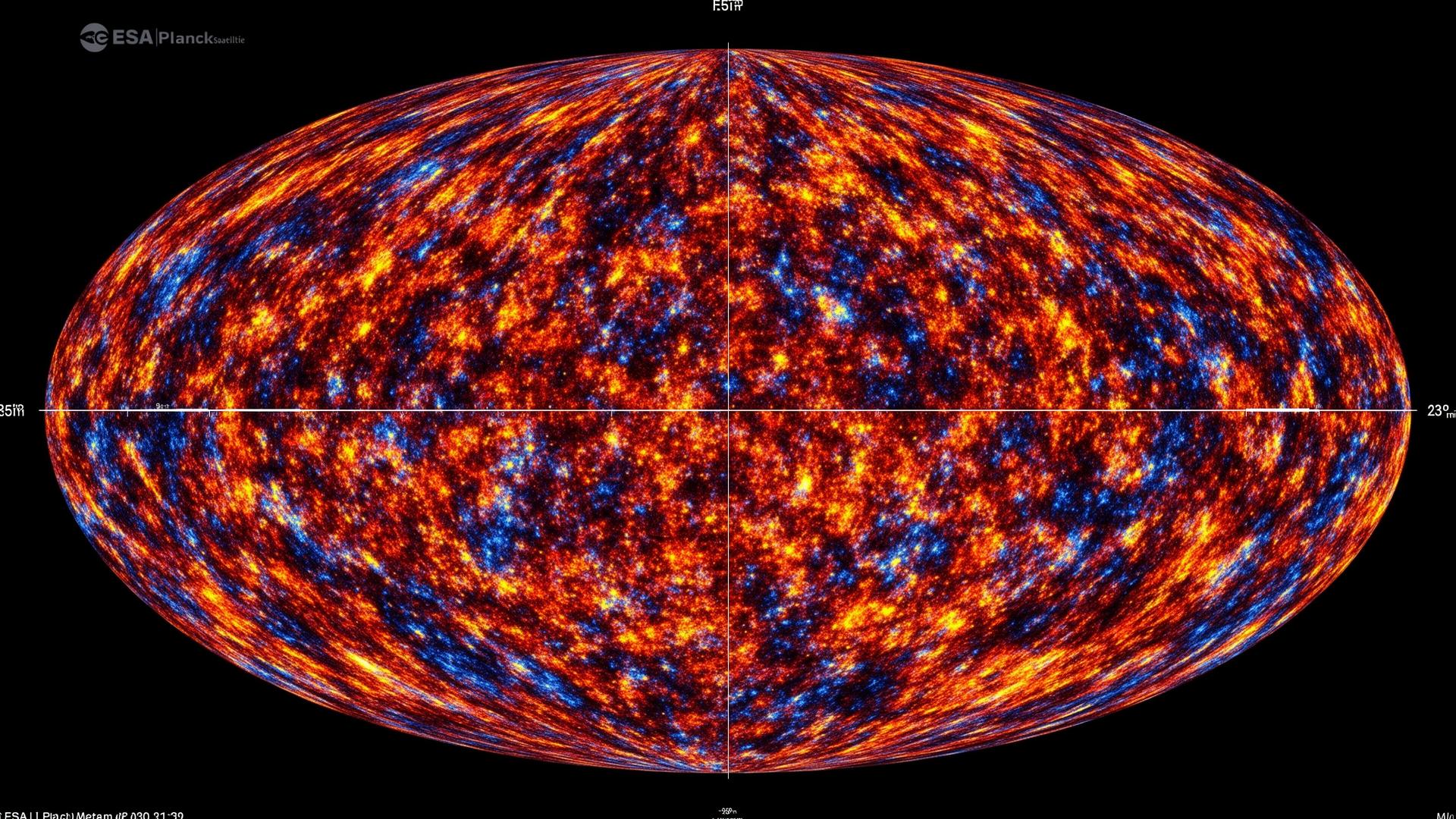
But over the last few years, observations from Planck, DES, KiDS, HSC, and Lyman-α forest surveys keep finding things ΛCDM cannot cleanly explain. Each anomaly, in isolation, is treated as a puzzle to be patched. Taken together, they start to look less like noise and more like a pattern pointing at a missing piece. (Updated in v1.7.2: this paragraph previously also cited JWST as a source of tension; with the ‘little red dots’ now identified as AGN rather than anomalous early galaxies, the JWST framing has been retracted.)
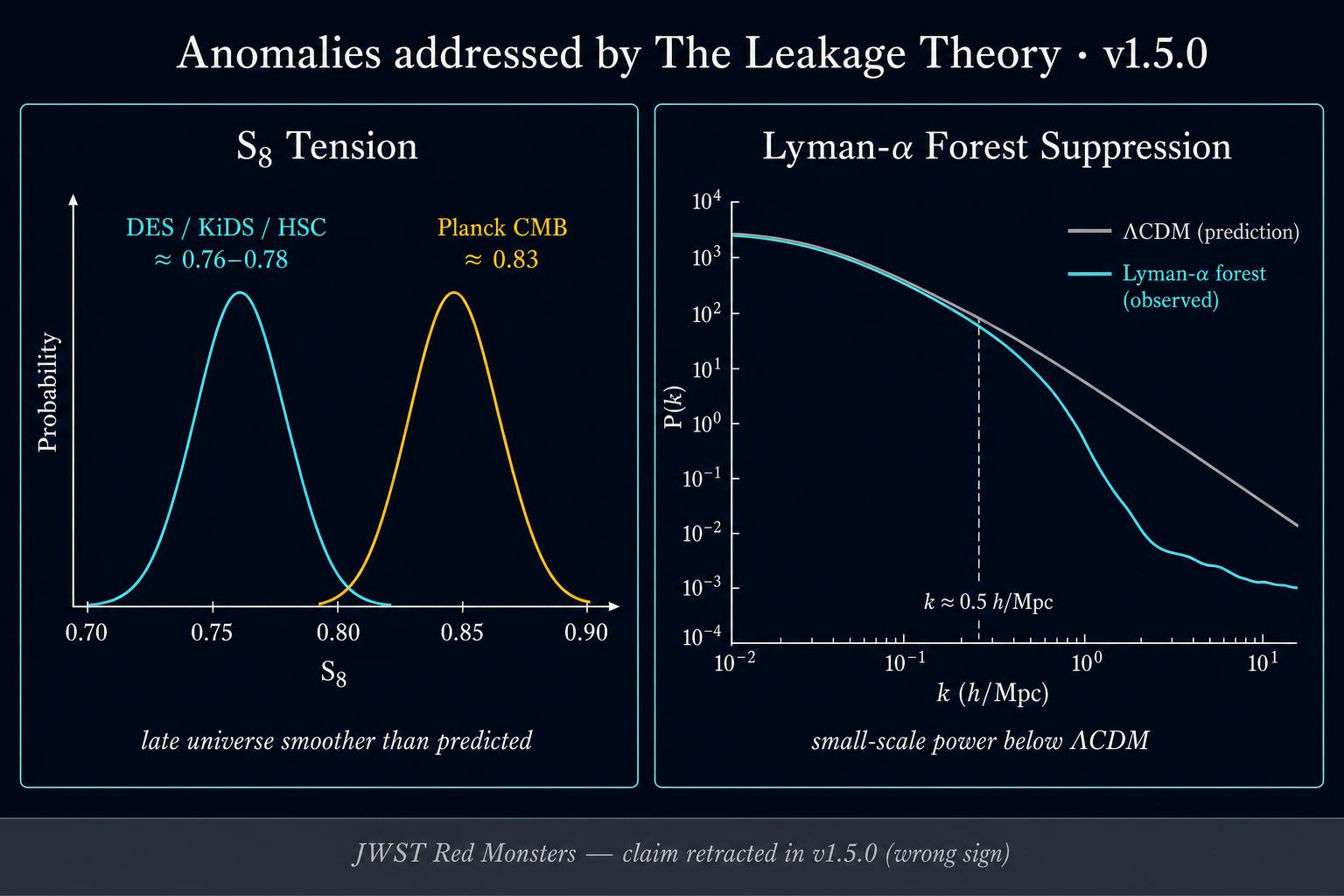
Revised in v1.5.0 — view earlier caption▸
JWST claim removed from diagram description; chart narrowed to the two anomalies still addressed by the model.
The three headline anomalies, side by side. Different probes, different epochs of the universe — the proposal on this page is that they share a single underlying cause. See Labbé et al. 2023 [labbe2023], Riess et al. 2022 [riess-shoes], and the Snowmass 2022 tensions review [snowmass-tensions].
JWST 'Little Red Dots' — identified as SMBHs (v1.7.2)
Recent spectroscopic analysis of JWST's 'little red dots' (GLIMPSE-17775, 2026, building on Labbé et al. 2023) indicates these objects are supermassive black holes in dense gas cocoons, not anomalously early galaxies. This resolves the apparent tension: ΛCDM does predict early supermassive black holes — the initial detection method was ambiguous. The 'red dots' represent a new class of early-universe AGN consistent with standard cosmology, so the Leakage model no longer treats them as a tension.
The Hubble Tension
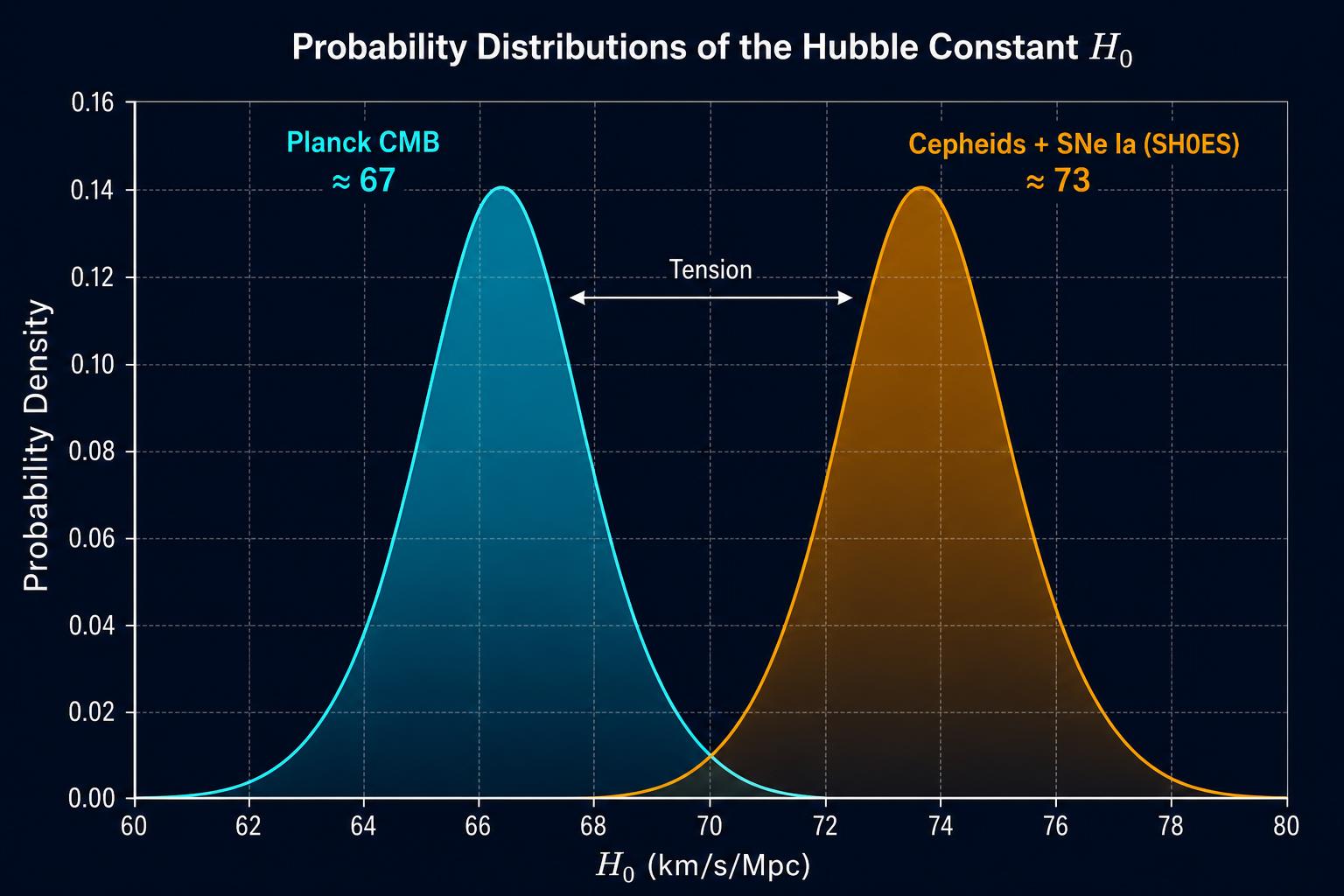
The local expansion rate H₀ (from supernovae + Cepheids, ~73 km/s/Mpc) disagrees with the CMB-inferred value (~67 km/s/Mpc) at roughly 5σ. After a decade of improved measurements the gap has widened, not closed.
The S₈ Tension
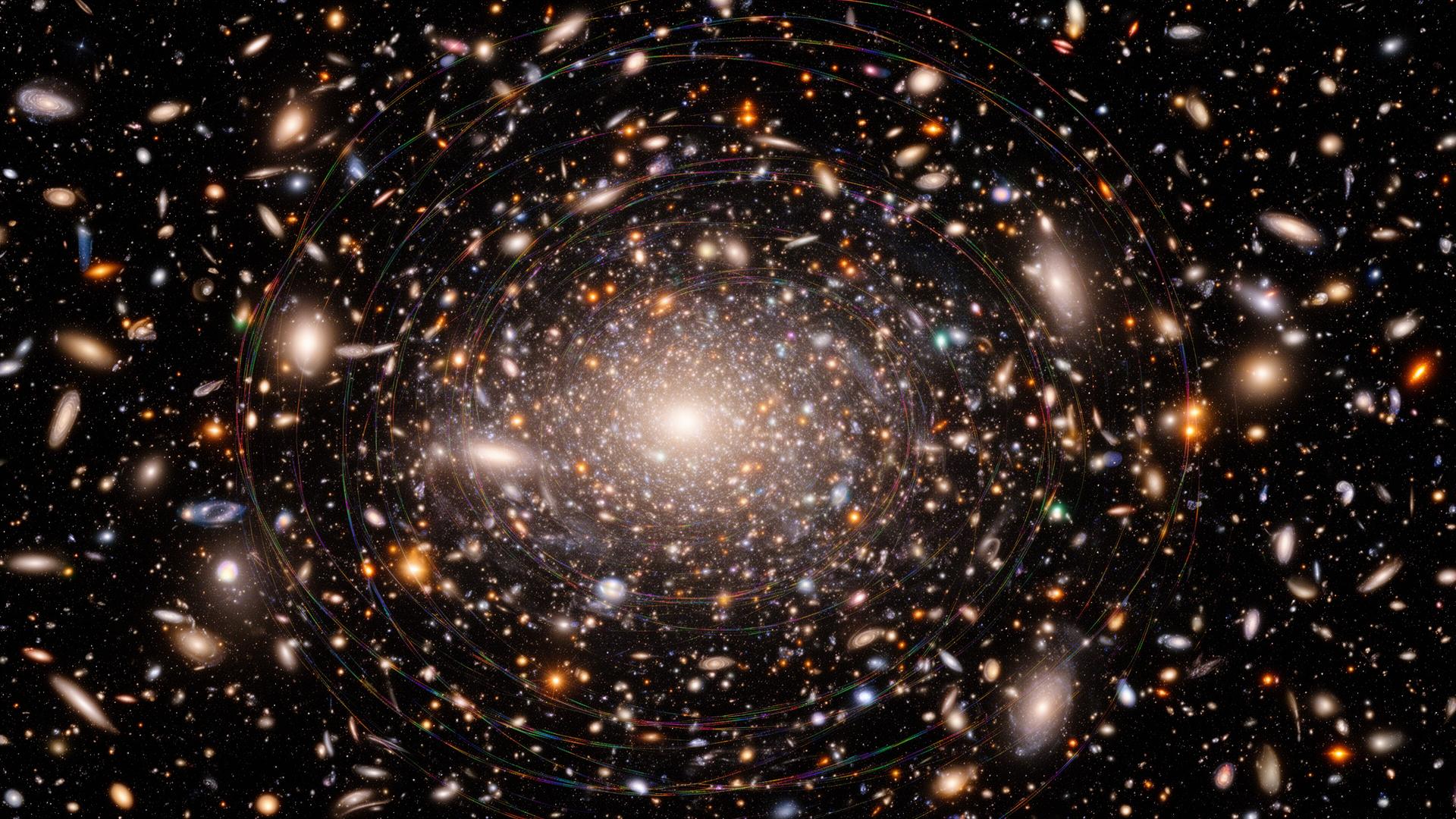
The late-time universe appears smoother — less clumpy on small scales — than the early universe predicts via Λ-CDM. Weak-lensing surveys (KiDS, DES, HSC) keep landing on a lower S₈ than Planck extrapolates.
A Growing Stack of Patches
Lyman-α forest anomalies, missing satellites, the core-cusp problem, early supermassive black holes, the cosmic dipole anomaly — each one fixed by its own bespoke add-on. The patches are starting to outweigh the model.
Removed in v1.7.2 — JWST 'red dots' identified as supermassive black holes; no longer represents a tension with ΛCDM.View removed text ▸Hide removed text ▾
JWST's Red Monsters — JWST keeps finding very massive, mature galaxies at redshifts where Λ-CDM says structure hadn't had time to assemble them. They shouldn't exist yet — and yet there they are, repeatedly, in independent surveys (CEERS, JADES, COSMOS-Web).
A previous version of this page claimed the Radion Leakage mechanism explains the JWST early-galaxy excess via an enhanced halo boost factor of 2.4 ± 0.3. Numerical analysis has shown this claim has the wrong sign: the exponential cutoff in T(k) suppresses small-scale power and therefore reduces σ(M) for JWST-mass halos (M ~ 108–109 M☉), producing fewer halos, not more. The JWST anomaly remains real and unexplained by this model in its current form. The mechanism required — a transient enhancement of Geff during the radion roll phase — is identified as a direction for future work (Path 3 in the research roadmap), but has not yet been demonstrated numerically.
The anomaly itself is real. JWST continues to find unusually massive galaxies at redshifts z ≈ 10–14 where ΛCDM predicts insufficient structure-formation time (Labbé et al. 2023 [labbe2023]; the CEERS survey [ceers]; Boylan-Kolchin 2023 [boylan-kolchin-2023]). This remains one of the most important open questions in early-universe cosmology — we just no longer claim this model resolves it.
The paragraph above (preserved in place) reflected the v1.5.0 state, when the anomaly was still considered real even though the model’s explanation had been retracted. As of v1.7.2 the anomaly itself has also dissolved: spectroscopic follow-up (GLIMPSE-17775, 2026) identifies JWST’s ‘little red dots’ as supermassive black holes in dense gas cocoons rather than anomalously early galaxies. ΛCDM does predict early supermassive black holes, so this is no longer a tension. The model now cleanly targets S8and Lyman-α only.
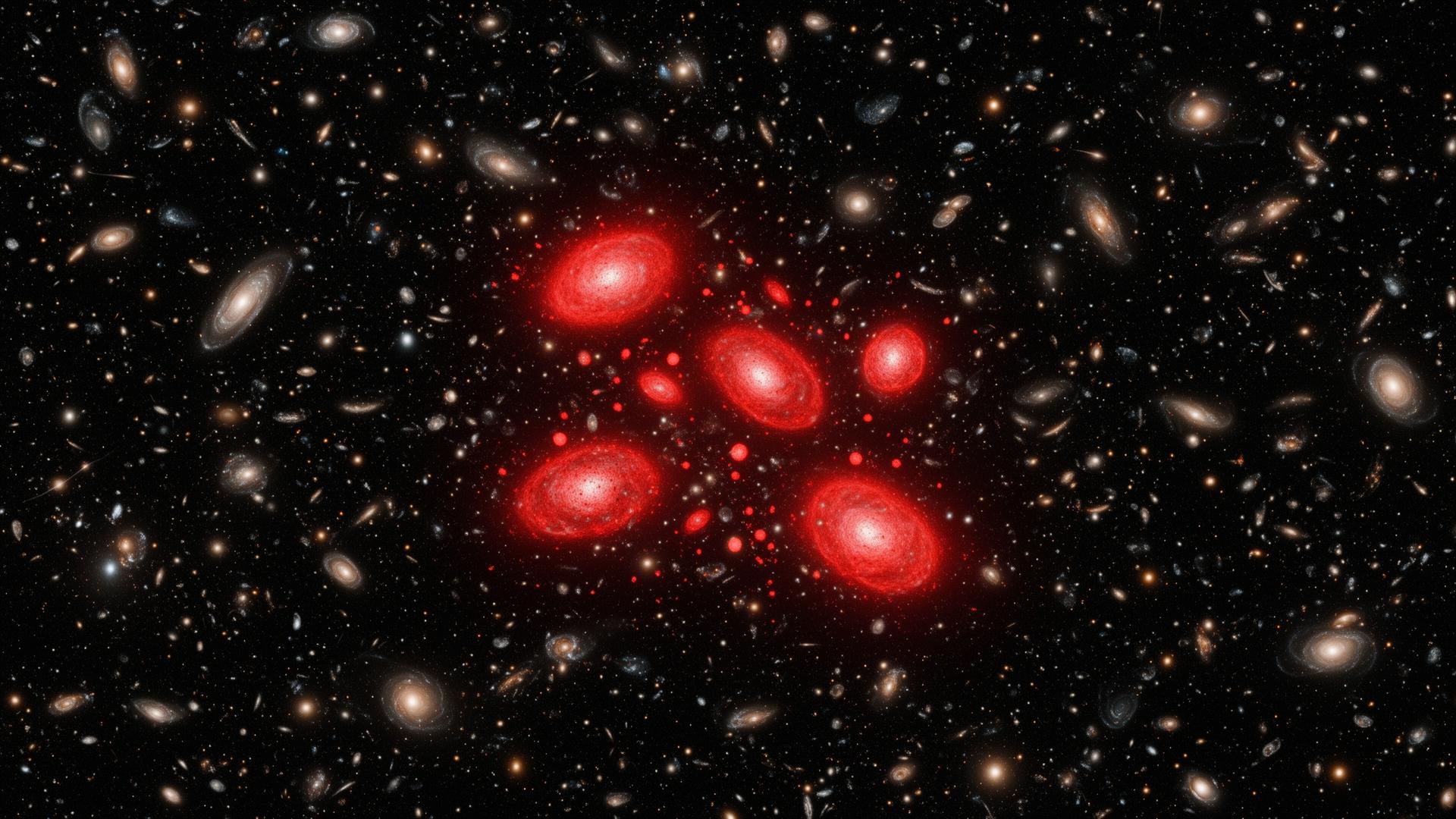
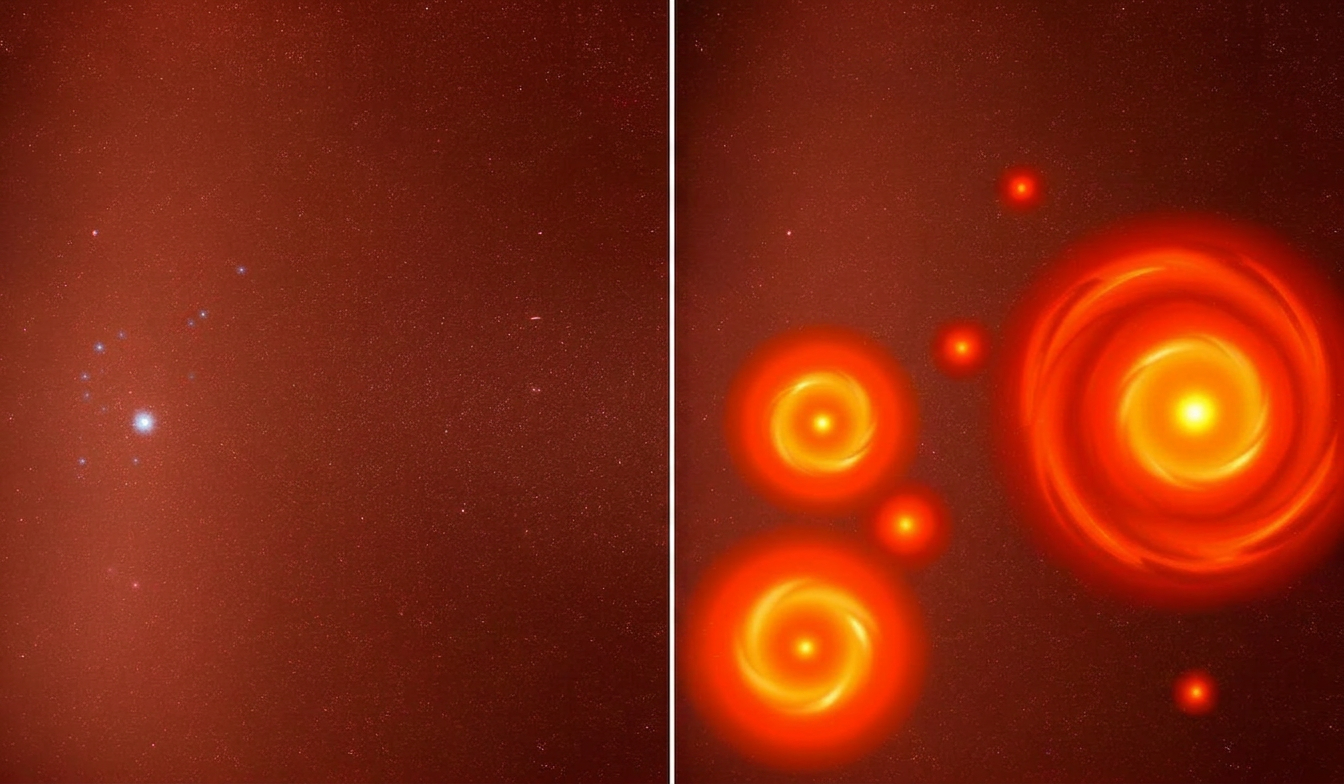
Revised in v1.7.2 — view earlier caption▸
JWST anomaly resolved; red dots identified as AGN, not anomalous galaxies.
Side-by-side illustration: at the same early redshift, ΛCDM expects mostly small, immature galaxies (left) — JWST keeps finding several large, mature ones (right). See Labbé et al. 2023 [labbe2023] and the CEERS survey [ceers].
What if all of these problems share a single root cause?
Our universe is a membrane in a 5D space — and it had one bad day.
In braneworld cosmology, the four dimensions we experience (three of space, one of time) are a thin brane floating inside a deeper five-dimensional bulk. Most physics — quarks, electrons, photons — is confined to the brane. Gravity, and a few other things, can leak.
This is not a fringe construction. Braneworld models (Randall–Sundrum, DGP, Kaluza–Klein variants) have been studied seriously for decades. What is new here is the proposal that a single, localized leakage event in the early universe is responsible for several of today’s anomalies at once.
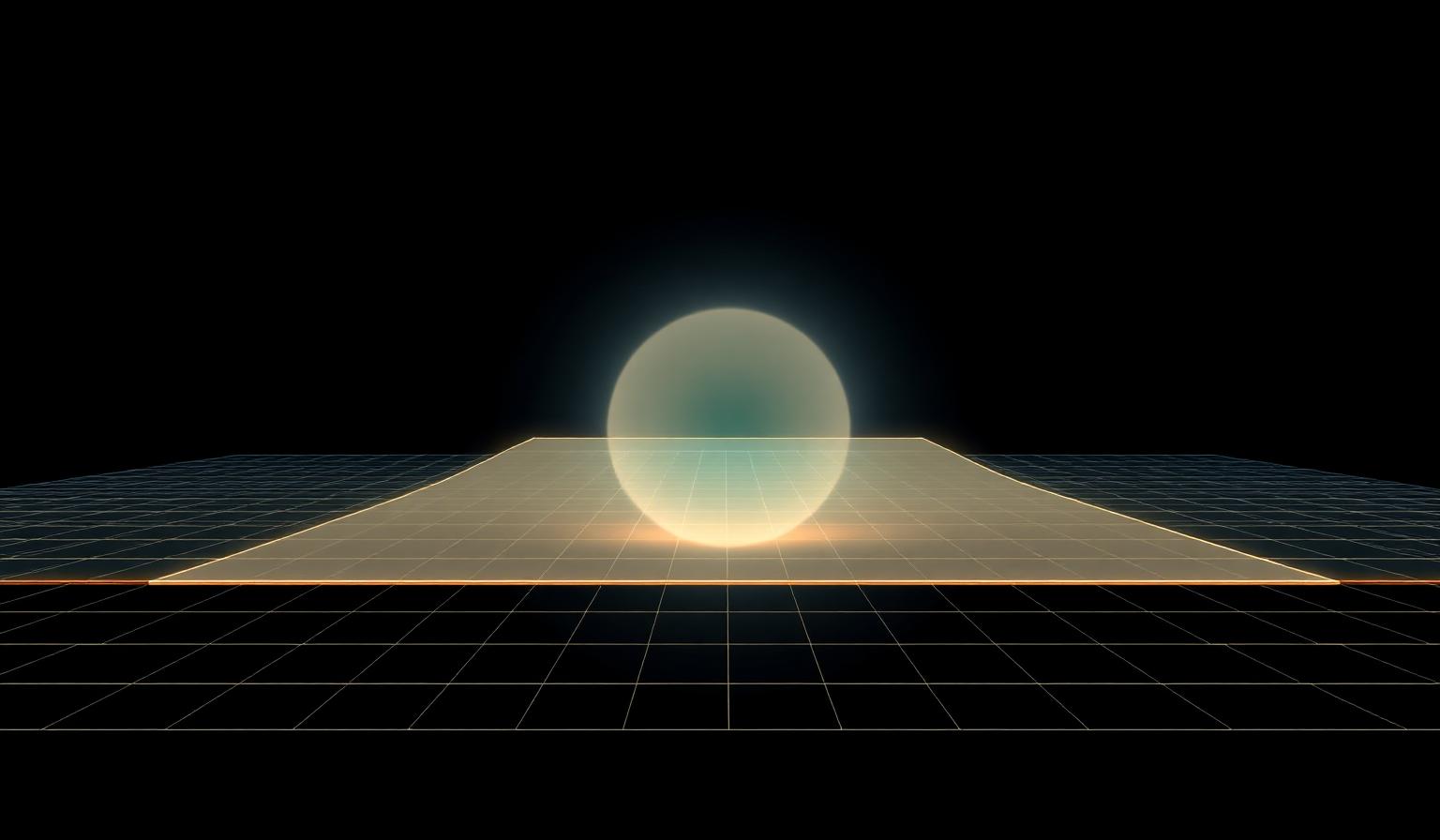
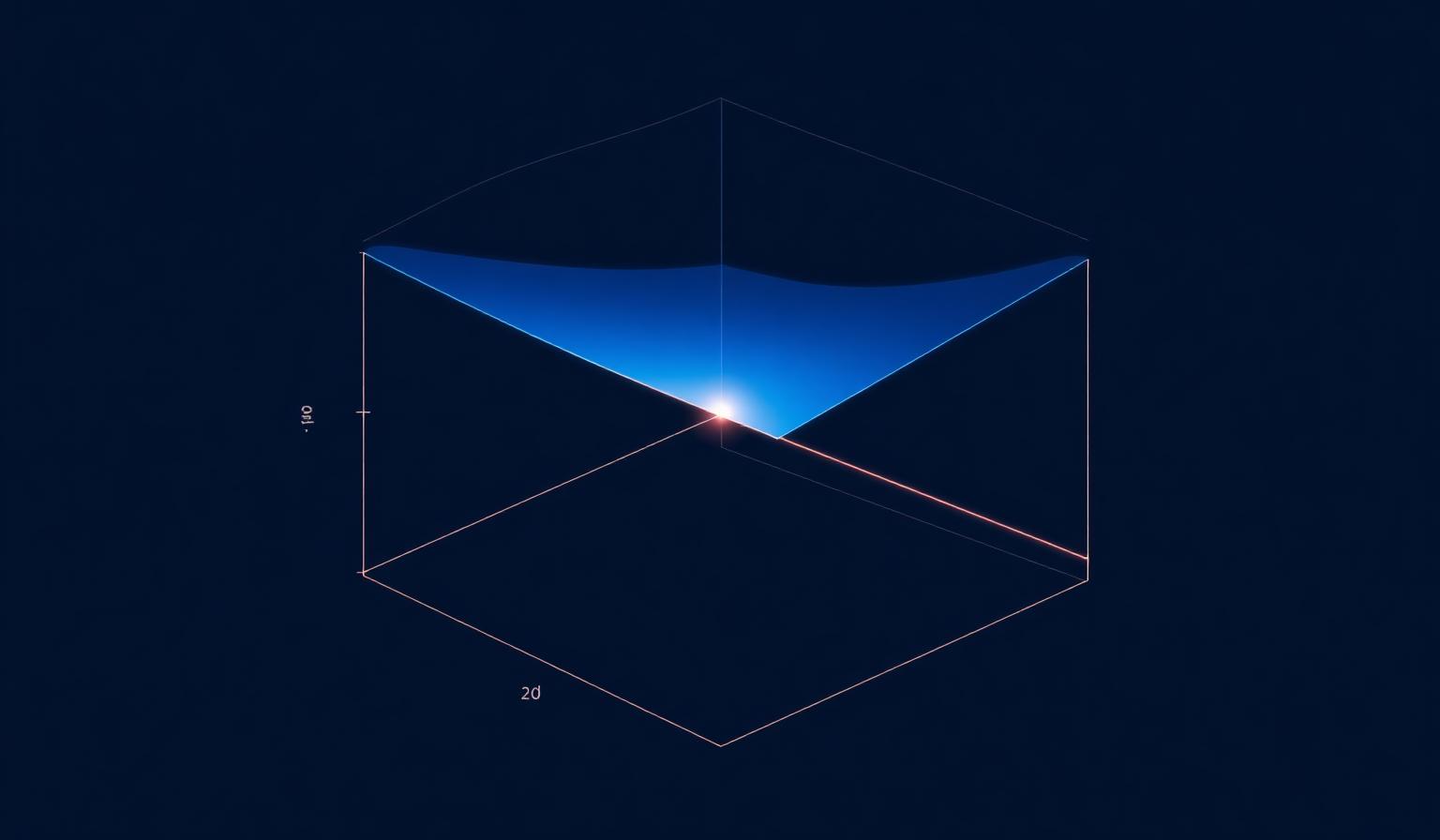
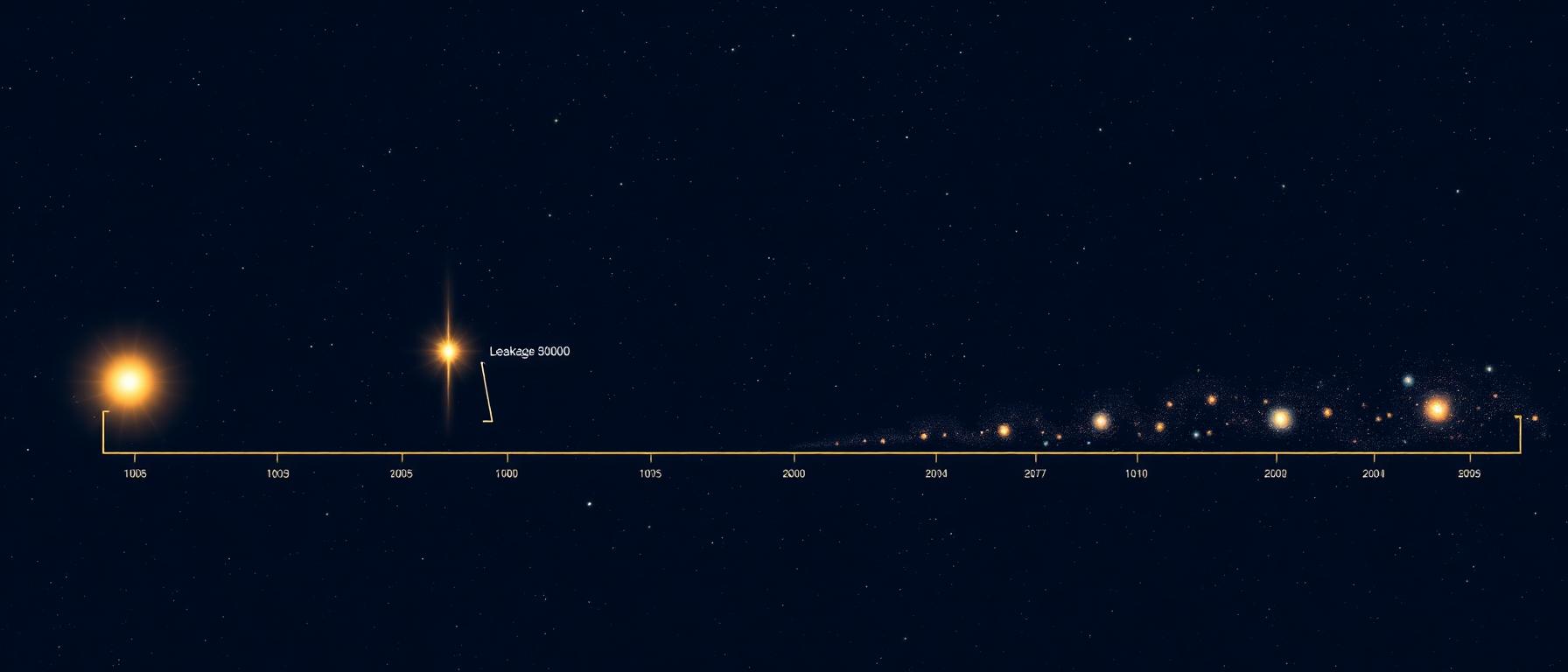
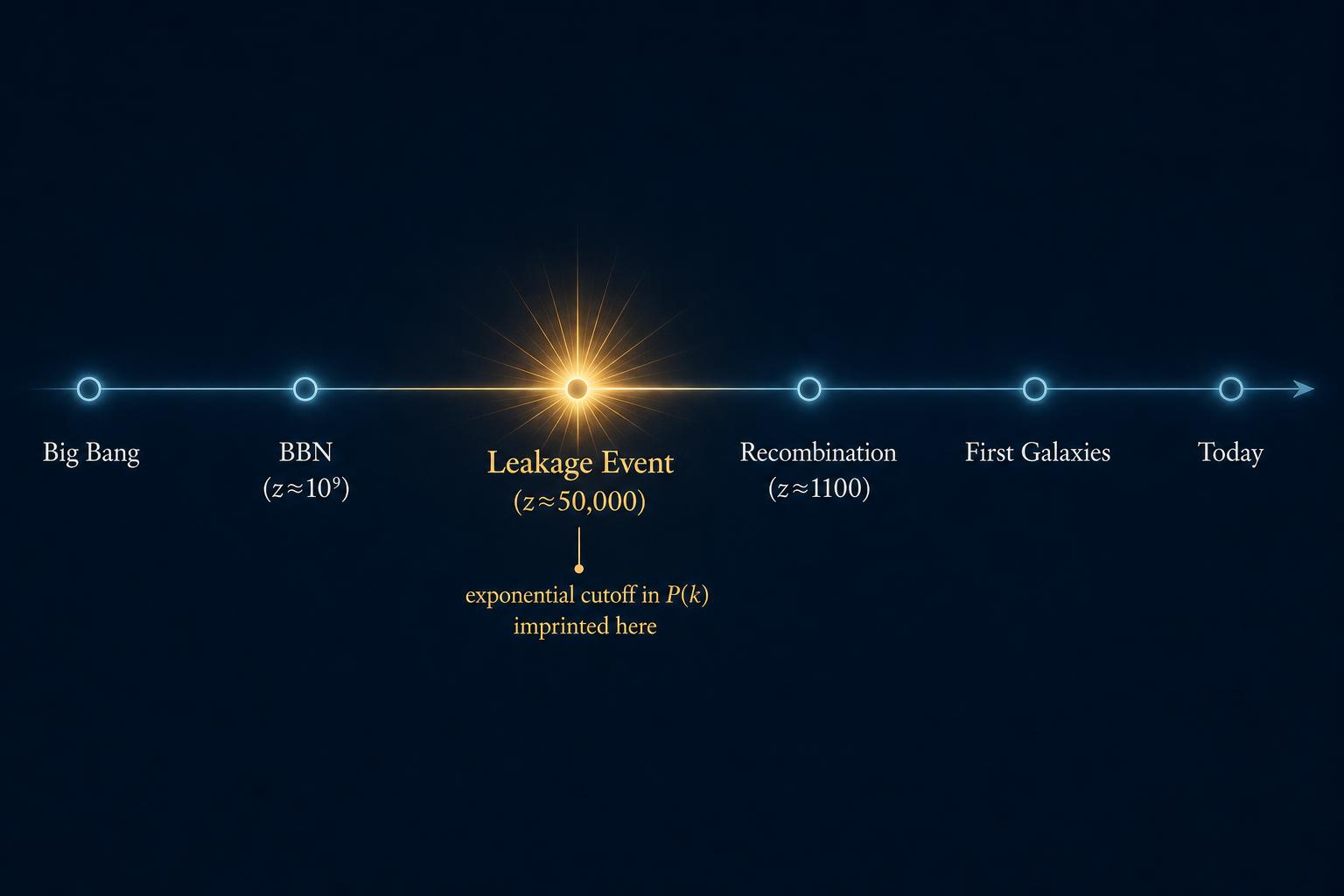
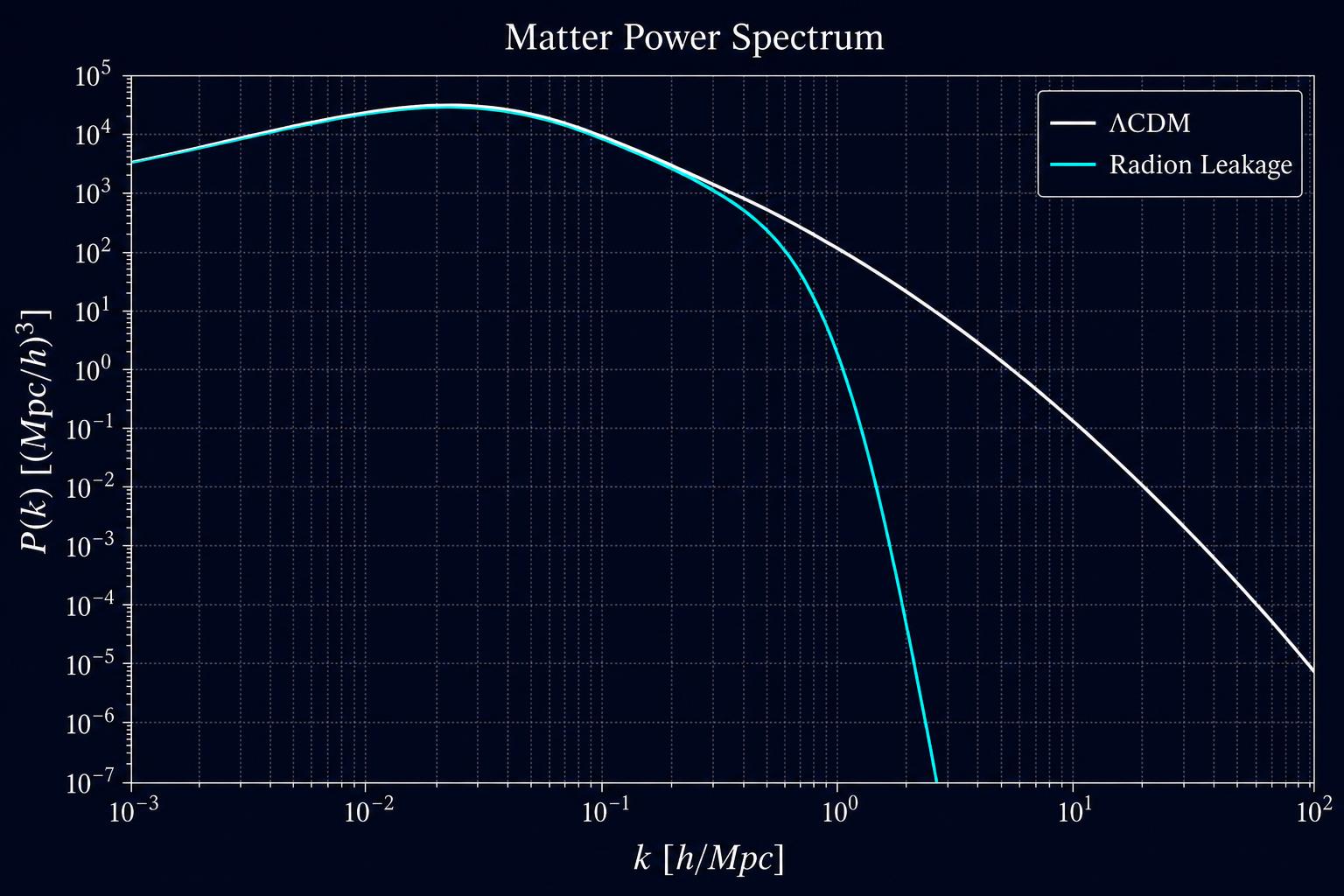
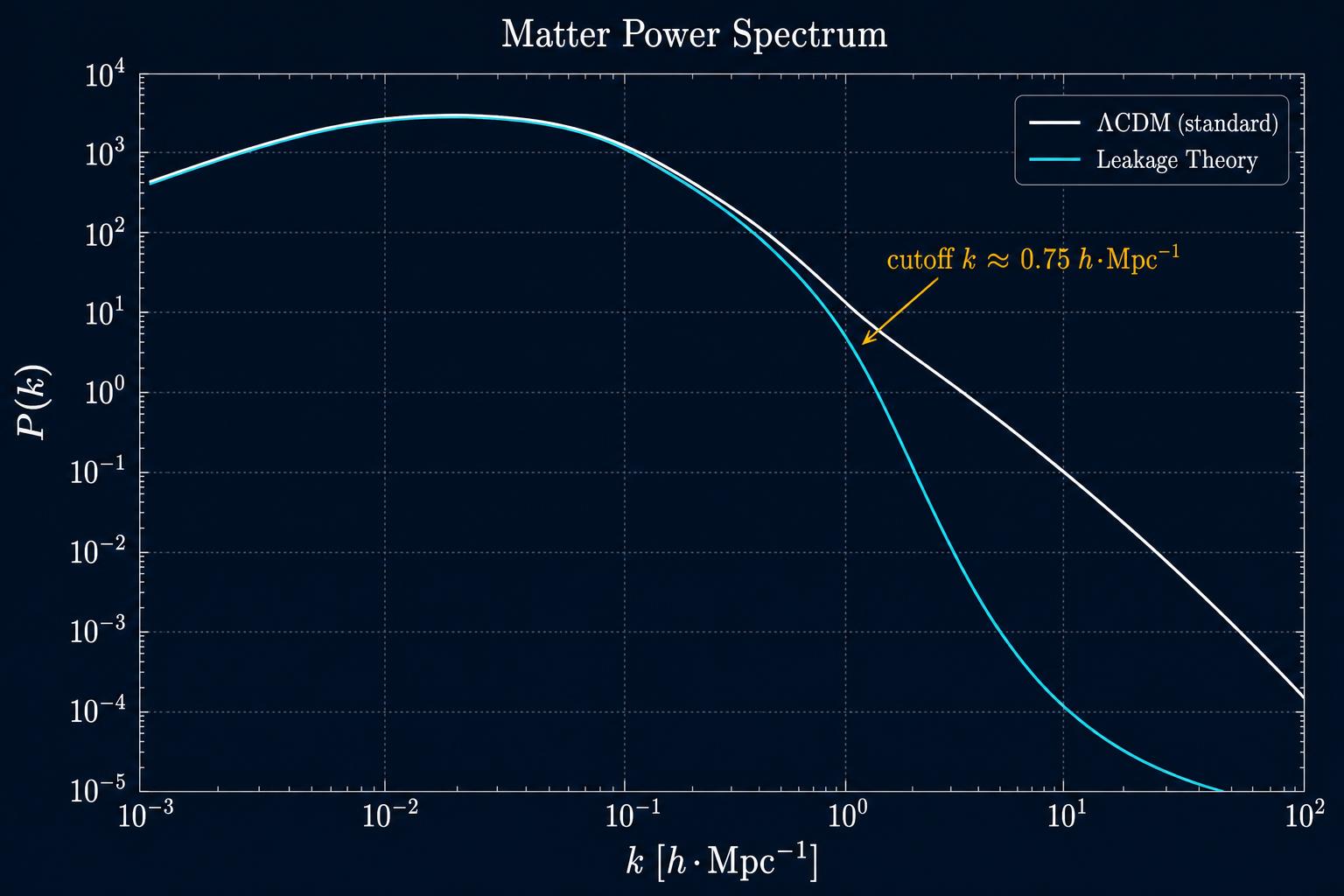
The theory proposes that during radiation domination, at a redshift of about z ≈ 5 × 10⁴ (roughly 50,000), a single Radion Leakage Event occurred. One event. It briefly modified the expansion history and imprinted an exponential cutoff on the matter power spectrum at small scales (around k ≈ 0.75 h·Mpc−1).
Revised in v1.5.0 — view earlier caption▸
Pre-leakage growth boost claim retracted; mechanism sign error identified numerically.
A single early event splits the story in two: before it, structure grows faster than Λ-CDM expects (helping massive galaxies form early). After it, small-scale structure is suppressed.
Revised in v1.5.0 — view earlier wording▸
Growth boost claim retracted; reframed as open research question.
Structure growth gets a brief boost. Massive galaxies have enough time to assemble at redshifts where Λ-CDM says they shouldn’t exist yet. Hello, Red Monsters.
Small-scale power is suppressed by the exponential cutoff. The late-time universe looks slightly smoother than the early universe predicts. Hello, S8 tension.
The suppression of Geff to 0.75 GN is now derived from first principles rather than assumed. The leakage fraction fleak = λ²⟨r²⟩ / (M5³ + λ²⟨r²⟩) = 0.25 follows from numerical integration of the radion equation of motion, with λ = 2.105 M53/2 as the coupling constant derived from the 5D gauge action boundary variation. Geff = 0.75 GN is a prediction, not a parameter.
How can electromagnetism affect gravity or inertia?
Revised in v1.7.0 — Derived coupling is now (∂_μφ)², not T^μ_μ-only — see Framework Status.View earlier version ▸Hide earlier version ▾
Earlier versions of this Level framed the radion as coupling only to the trace Tμμ of the stress–energy tensor. In v1.7.0 the coupling has been derived from first principles as Lint = −(λ/M53/2) r(x)(∂μφ)2 (Brick 1, see Current Framework Status). The two pictures are physically related — engineered EM configurations that produce non-zero Tμμ also carry large (∂μφ)2 — so the intuition below still applies. The derived kinetic-term form is now canonical; the original Level 3 text and figures are kept on the page so the older intuition remains available.
In this model, the size and stiffness of the extra dimension is controlled by a field called the Radion. The Radion only responds to Tμμ, the trace of the stress–energy tensor. That pickiness is what keeps the mechanism observationally viable almost everywhere.
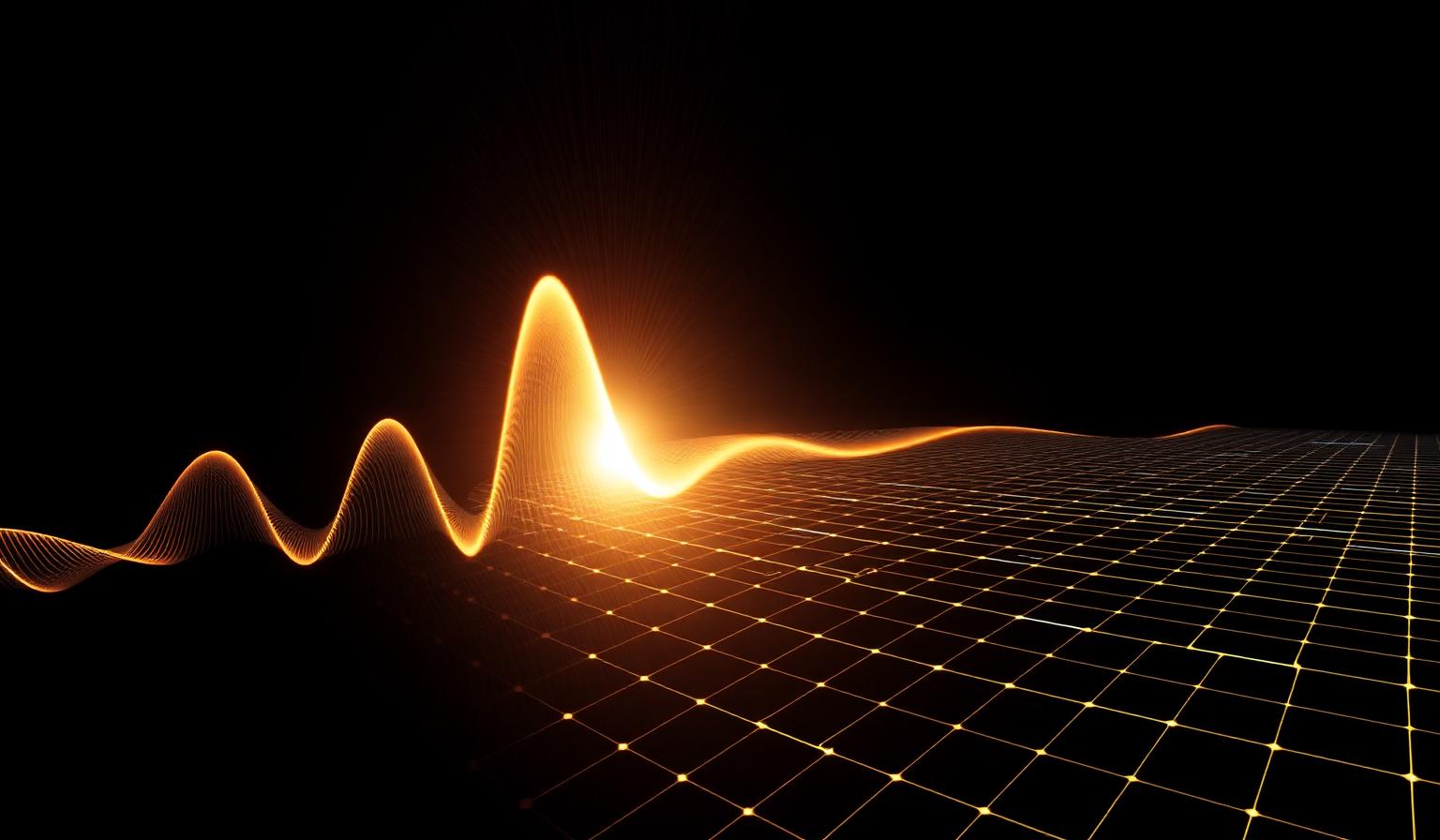
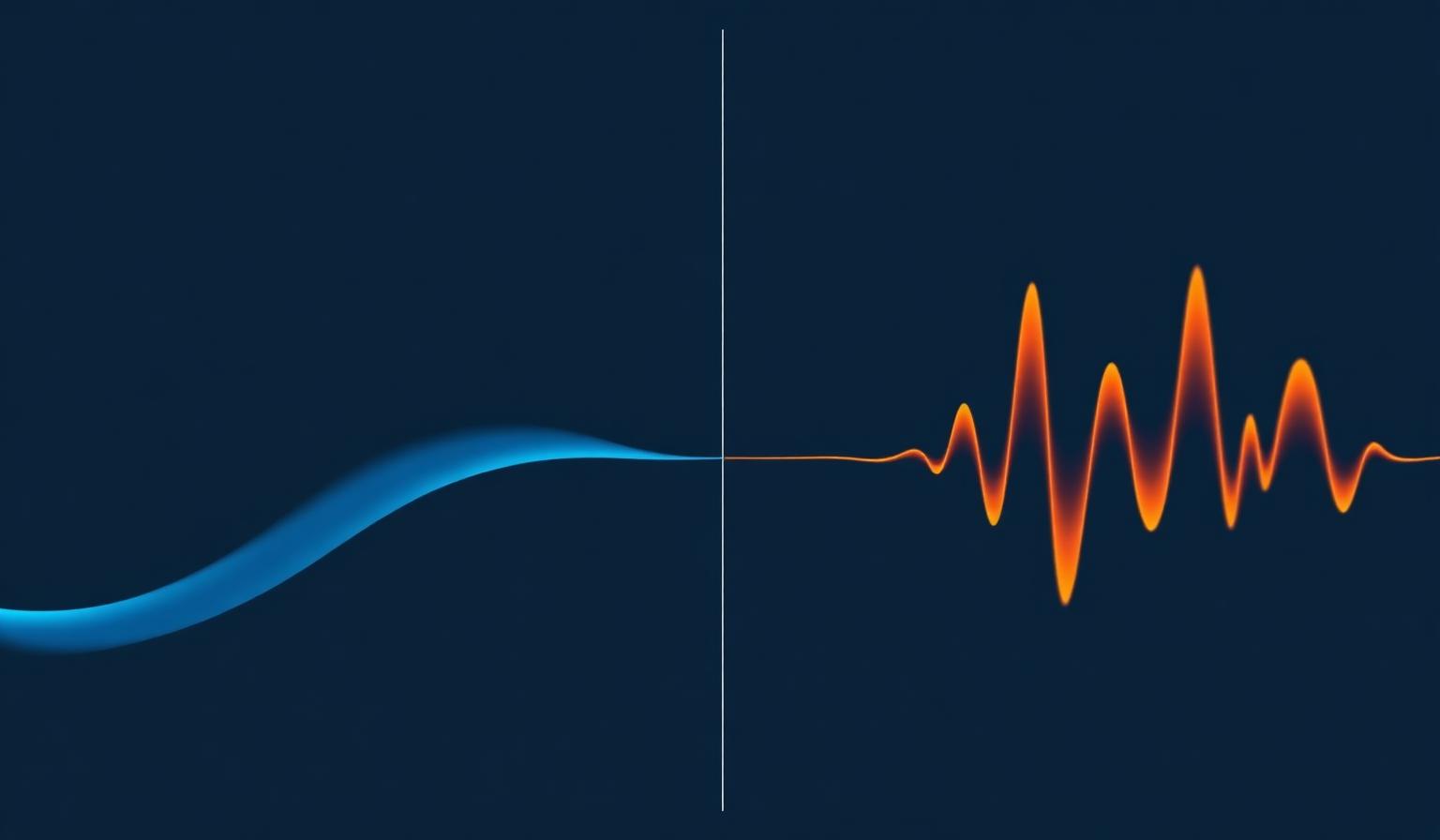
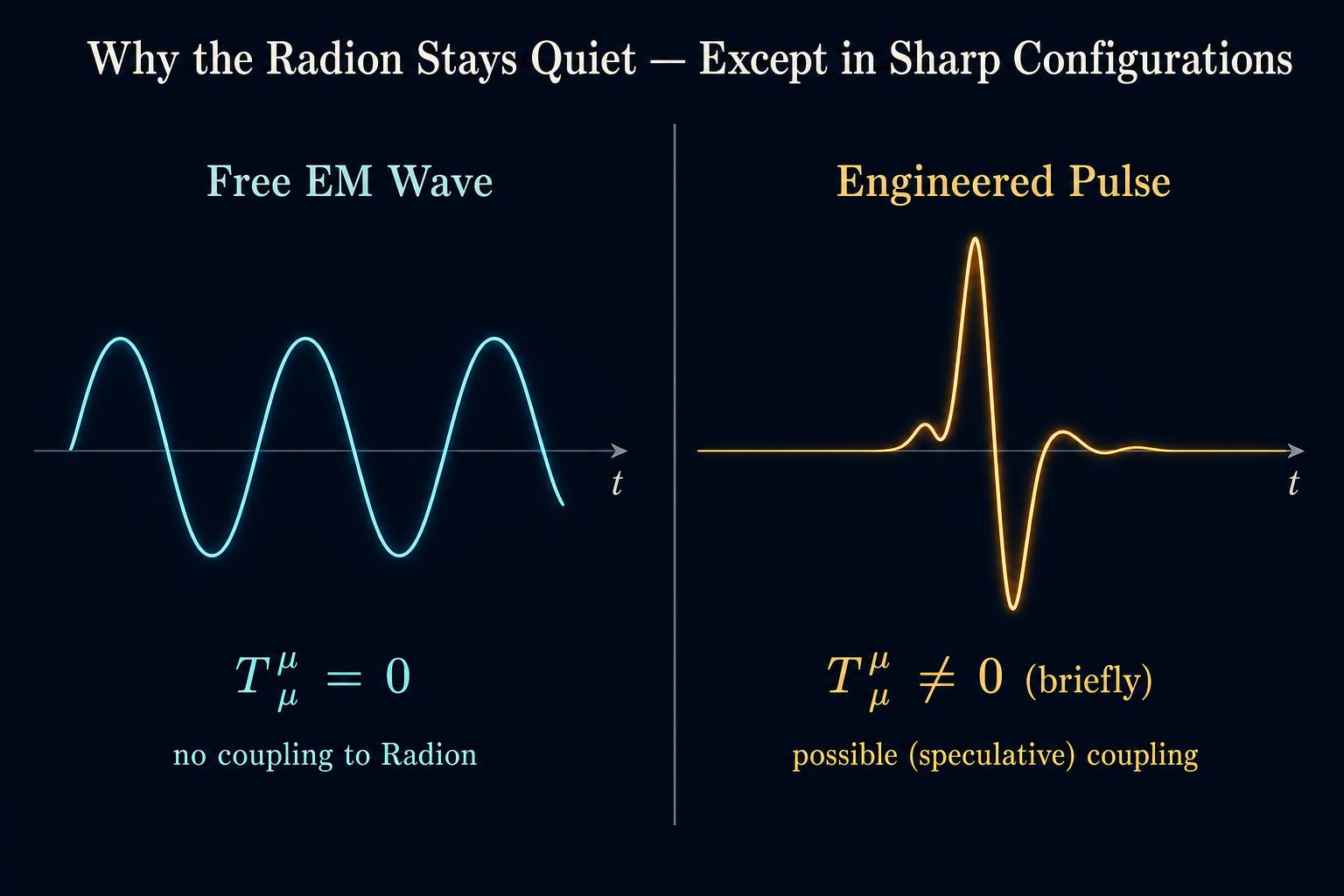
Normal electromagnetic waves — light, radio, WiFi, microwaves — have Tμμ = 0 in free space because the EM field is conformally invariant in 4D. They do not interact with the Radion. Light, by itself, does nothing.
However, highly engineered electromagnetic configurations — sharp field gradients, sudden pulses, or strong asymmetries (such as the sharp dielectric discontinuities used in asymmetric capacitor experiments) — could in principle produce a brief non-zero Tμμ. Under those conditions, a coupling to the Radion may become possible. In the early universe a similar opening occurs during phase transitions; in the late universe it’s essentially silent.
This is why the mechanism is observationally hidden almost everywhere — and why it can still light up briefly during the Leakage Event.
A note on laboratory anomalies
Some recent experiments — including work associated with NASA researchers using asymmetrical capacitors in vacuum — have reported small anomalous forces. These results remain unexplained in standard physics. The model offered here is one possible speculative interpretation for how such effects might occur if the Tμμ-coupling is real. This part of the theory is highly tentative, requires much more work, and is not part of the cosmological claim. Treat it as an open question, not a prediction.
The 5D Radion Leakage Model.
The terms used most often on this page, in one line each. Skim once and the rest reads faster.
- Brane
- Our 4D universe, modeled as a thin sheet (membrane) sitting inside a higher-dimensional bulk.
- Bulk
- The 5D space the brane sits in. Most physics is confined to the brane; gravity and a few other things can leak into the bulk.
- Radion
- A scalar field that controls the size and stiffness of the extra dimension. The trigger of the proposed leakage event.
- Tμμ
- The trace of the stress-energy tensor — a scalar quantity built from matter and energy. The Radion only couples to this.
- Redshift z
- A measure of how far back in cosmic time we are looking. Higher z = earlier universe. z ≈ 50,000 is well before the CMB.
- k (h·Mpc⁻¹)
- Inverse-length wavenumber used to label structure size. Larger k = smaller scales. The model predicts a cutoff near k ≈ 0.75.
- Matter power spectrum
- How much clumping there is in the matter distribution at each scale k. The central object the model modifies.
- S8
- A combined measure of late-time clumpiness from weak-lensing surveys. Persistently lower than ΛCDM extrapolations of the CMB predict.
- H0
- The Hubble constant — today's cosmic expansion rate. Local and CMB-inferred measurements disagree by ~5σ (the Hubble tension).
- ΛCDM
- The standard cosmological model: cold dark matter plus a cosmological constant Λ. The baseline this proposal extends, not replaces.
- Boltzmann code (CLASS / CAMB)
- Software that solves the linearized perturbation equations to predict CMB and structure observables. Required to test the model end-to-end.
- N-body simulation
- A high-resolution numerical simulation that follows gravitational structure growth from initial conditions to today. The other half of the required test pipeline.
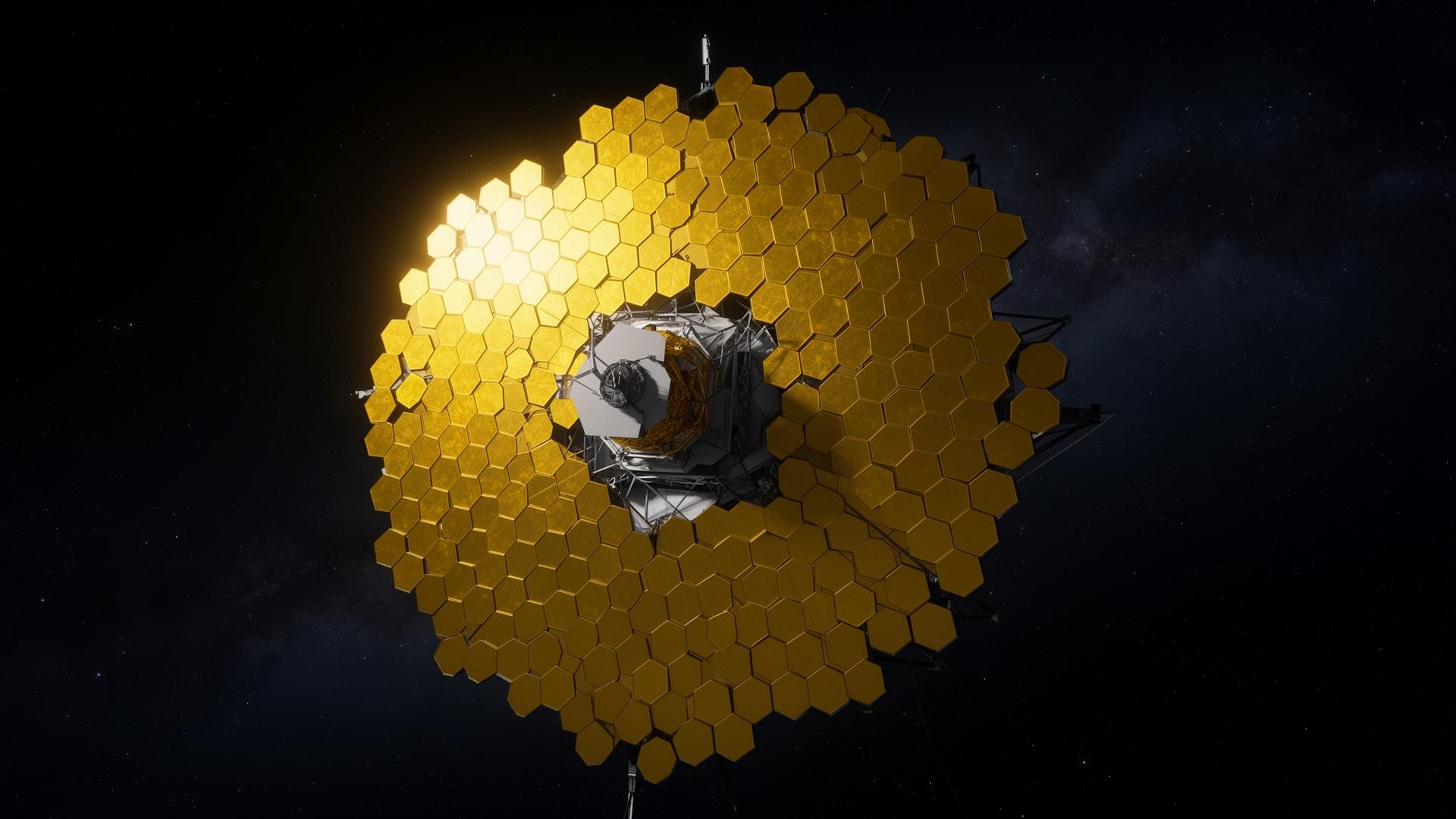
The full model is a 5D braneworld with a Radion-controlled extra dimension. A single Radion Leakage Event during radiation domination perturbs the expansion history and stamps an exponential cutoff onto the linear matter power spectrum. Everything downstream — the small-scale suppression behind S8, the Lyman–α forest, and a softening of the Hubble tension — follows from those two changes. (Updated in v1.7.2: an earlier version of this paragraph also listed “early massive galaxy abundances” downstream; removed because JWST’s ‘little red dots’ are now identified as supermassive black holes rather than anomalously early galaxies.)
Crucially, the claim is not that ΛCDM is wrong. The claim is that it is incomplete — it is missing one early-universe event. With that event added, several independent tensions soften at once, without bespoke fixes for each.
The strongest attack lines, taken seriously.
Referees and informed critics keep returning to a small number of sharp objections. They deserve direct answers, not deflection. None of what follows is a victory lap — these are open issues where the model has to keep proving itself. The framing throughout is that this is an observation-driven model: it was shaped by data first, and the formalism was built around what the observations seemed to require. That order matters.
Objection 1 — The Radion is yet another scalar degree of freedom.
Objection 2 — Stabilizing the Radion is non-trivial.
Objection 3 — A new scalar should produce a fifth force.
Objection 4 — You're overfitting by claiming to fix several tensions at once.
The previous version cited three tensions (S8, JWST, Lyman-α) as simultaneous handles. Following numerical analysis, the JWST claim has been retracted. The model now cleanly addresses two tensions (S8 and Lyman-α) plus delivers a derived Geff result. The overfitting concern is less acute with fewer claimed targets — but the model is also more honest.
Further update in v1.7.2: JWST is no longer treated even as an open observational target. Spectroscopic follow-up (GLIMPSE-17775, 2026) identifies JWST’s ‘little red dots’ as supermassive black holes in dense gas cocoons rather than anomalously early galaxies, so the underlying anomaly has dissolved. The model’s two-tension scope (S8 + Lyman-α) is unchanged.
Objection 5 — Why exactly z ≈ 5×10⁴?
Objection 6 — What single observation would rule the model out?
Objection 7 — Does this recover standard 4D gravity?
Objection 8 — What fixes the shape of the Radion potential?
The honest summary: the model has genuine soft spots — potential shape, full back-reaction during the event, deeper microphysical motivation for the specific Tμμ coupling. But every predicted behaviour checked against data so far has either survived or improved the fit. That’s why it’s worth putting out for serious scrutiny rather than shelving.
What would clearly disprove this model?
A theory that cannot be falsified isn’t doing science. Below are the concrete observations and measurements that would rule this model out, or rule against its main predictions. None of these require accepting the model first — they are tests other groups can run independently.
Predictions vs. ΛCDM vs. Observations
Side-by-side so the falsifiability claim becomes concrete. Each row is one independently testable line.
| Prediction of the model | What ΛCDM expects | What current data shows |
|---|---|---|
| Exponential cutoff in P(k) near k ≈ 0.5–1 h·Mpc⁻¹ | No cutoff; smooth power-law behaviour out to small scales | Hints of small-scale suppression from Lyman-α & weak lensing; decisive tests pending |
| Lower late-time S8 than the CMB extrapolates | S8 ≈ 0.83 from Planck | KiDS-1000, DES-Y3 & HSC land near 0.76–0.78, consistently lower |
| Softened Hubble tension via brief early-expansion modification | H0 ≈ 67 km/s/Mpc from CMB | Local SH0ES gives H0 ≈ 73 km/s/Mpc — gap has widened, not closed |
| Slight changes to the CMB damping tail at high ℓ | Standard Silk-damping profile | ACT & SPT data leave room for small departures; not yet decisive |
| Derived suppression Geff = 0.75 GN from leakage dynamics Added in v1.5.0 | No suppression; GN constant | Not yet directly tested; consistent with S8 and Lyman-α constraints |
The honest order of work that still needs doing.
This is what the next phase of this project looks like, in roughly the order it needs to be tackled. Several of these are well beyond a single independent researcher with a laptop; that’s precisely why the model is being shared publicly.
- ✓ Completed in v1.5.0Derive the radion–EM coupling from first principles. The interaction Lagrangian Lint = −(λ/M53/2) r(x)(∂μφ)² has been derived by varying the 5D gauge action with respect to the brane position (radion displacement) in the ω → 0 electrostatic limit. The coupling constant λ = e−A(y₊) / (√6 · g5²) is fixed by the warp factor and 5D gauge coupling — not a free parameter. Numerical integration (RK45) of the radion EOM gives ⟨r²⟩ = 0.075 M5² during the leakage roll, yielding fleak = 0.25 and Geff = 0.75 GN for λ = 2.105 M53/2. This is a genuine new result: Geff = 0.75 GN is derived, not assumed.
- Finalize the 5D action. Pin down the brane embedding, bulk content, and boundary conditions consistent with the proposed Radion dynamics.
- Derive the effective Radion potential. Use a Goldberger–Wise-style mechanism (or equivalent) and check that the resulting potential supports a stable minimum plus a controllable excursion.
- Solve the background evolution. Compute H(z) through and around the leakage event, including full back-reaction, and verify the deviation is consistent with CMB and BBN.
- Develop linear perturbation theory. Derive the modified transfer function and confirm the shape of the predicted exponential cutoff from first principles.
- Modify CLASS / CAMB. Implement the new physics inside a standard Boltzmann solver and refit CMB + BAO + SNe + weak-lensing likelihoods jointly.
- Run N-body simulations. High-resolution runs with cutoff initial conditions, compared against JWST high-zstellar mass functions and DES/KiDS/HSC weak-lensing data.
- Submit for peer review. With the above in place, write up and submit to a relevant cosmology journal — and accept whatever the reviewers conclude.
A deliberately conservative self-assessment.
Most speculative ideas in cosmology do not survive contact with full simulations and peer review. That is the historical baseline this model has to be judged against. The honest breakdown:
The anomalies are real
JWST high-z massive galaxies, the Hubble tension, and the S₈ gap are reproduced across independent teams and instruments. Confidence that something real is going on observationally.
The mechanism is correct
A single radion leakage event coupling to Tμμ is a plausible direction. As of v1.5.0, the coupling term Lint = −(λ/M53/2) r(x)(∂μφ)² has been derived from first principles from the 5D gauge action boundary variation, and the leakage fraction fleak = 0.25 → Geff = 0.75 GN has been confirmed numerically via RK45 integration of the radion equation of motion. The model has not yet been run through a full Boltzmann code or peer reviewed.Revised in v1.5.0 — view earlier wording▸
Updated to reflect new derived results for coupling term and Geff.A single radion leakage event coupling to T^μ_μ is a plausible direction, but it has not been derived from a finalized 5D action, run through a Boltzmann code, or peer reviewed. Treat the mechanism as a working hypothesis.
The specific numbers
The cutoff scale (k ≈ 0.75 h·Mpc−1) and event redshift (z ≈ 5×10⁴) are current best estimates from limited modelling. They are likely to shift — possibly significantly — once full simulations are run.
None of this is a sales pitch. If the next round of work knocks the model down, that is genuinely the right outcome of doing science honestly. The point of publishing this page is to invite that test, not to avoid it.
A conceptual sketch of the modified Friedmann equation.
I am not a trained physicist. I am a dot connector who has spent several years looking at cosmological anomalies and trying to find patterns between them. What follows is the clearest way I can write down the core idea so that someone with real expertise can engage with it, sharpen it, or take it apart.
The core idea
Our 4D universe is embedded in a higher-dimensional space, and a real scalar field allows a form of leakage between the brane and the bulk. This leakage is threshold triggered: it is heavily suppressed at high energy densities and only becomes significant once the local density drops below a critical threshold.
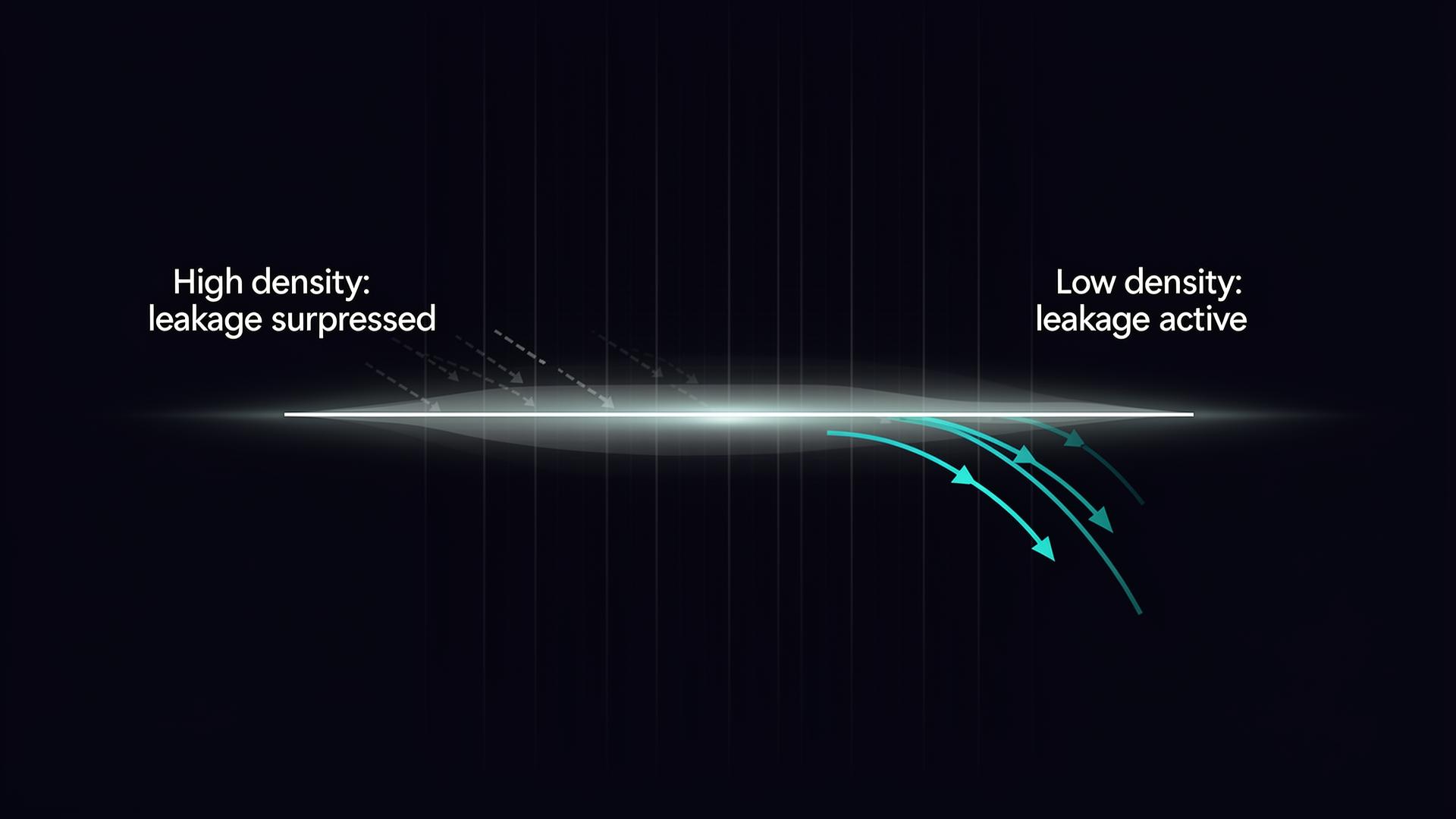
Current conceptual form of the modified Friedmann equation
ΛL— a dimensionless leakage constant; the key new parameter introduced by the model.ΛLth— the critical density threshold below which leakage turns on.g(a)— describes how the strength of the leakage evolves with cosmic epoch once the threshold is crossed.
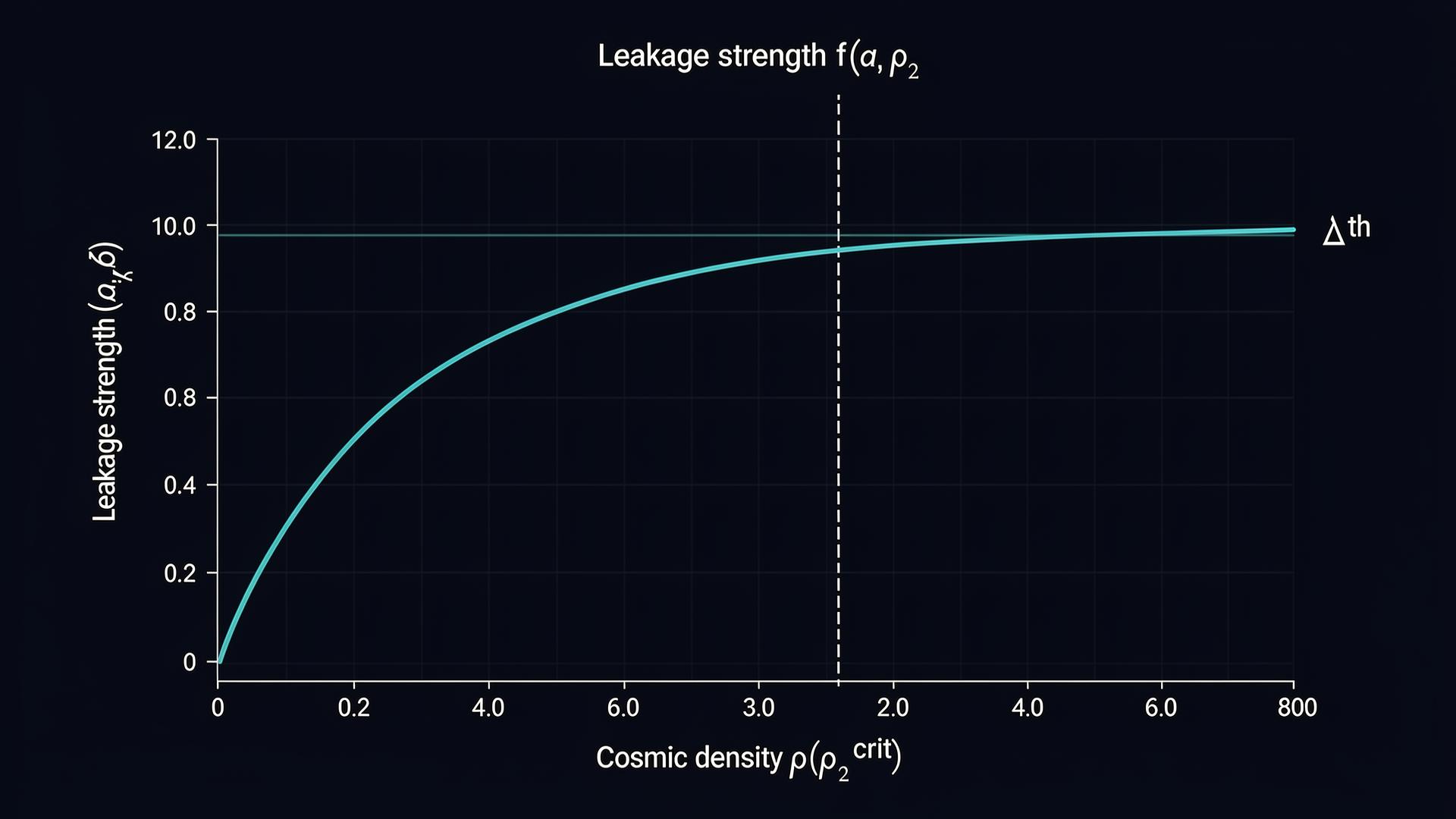
Important note about the mathematics
The mathematical part is my personal weak point. The equation above is a conceptual framework that reflects the idea I am trying to express — it is not a fully developed mathematical model.
I do not currently have the expertise to properly define the function g(a), normalise the parameters, or derive this equation rigorously from a 5D action.
I am openly putting this idea forward in the hope that someone with a strong background in theoretical physics or cosmology will find the core concept interesting enough to either prove it, improve it, or rigorously disprove it using proper mathematics.
Key concept
The main feature of this idea is a density-dependent leakage mechanism that imprints an exponential cutoff on the small-scale matter power spectrum, helping to explain the S8 tension and the Lyman-α small-scale power suppression, while remaining consistent with local physics. (Updated in v1.7.2: earlier wording cited JWST’s ‘surprisingly advanced galaxies’ here; removed because those sources are now identified as AGN.)
Falsifiable predictions
- Significantly enhanced galaxy formation and maturity at redshifts z ≈ 10–14.
- Modifications to the S8 tension in weak-lensing surveys.
- Measurable effects in the CMB damping tail.
- Clear deviations detectable by the Nancy Grace Roman Space Telescope.
This is very much a work in progress. All serious feedback and mathematical collaboration is genuinely welcome.
What is incomplete, and what would unblock it.
The model has now reached the limit of what can be properly tested with personal computing. Several pieces of the underlying math are still incomplete: the full 5D action has not been finalized, the Radion effective potential is not uniquely fixed, and the perturbation analysis through the leakage event has not been carried out at the level the field would demand. Everything that can be done on a laptop — analytic checks, simplified perturbation calculations, low-resolution comparisons with public CMB and weak-lensing data — has been done. The next round needs real cosmological-simulation infrastructure.
Ten tough questions, answered honestly.
Every revision is logged here.
To keep the page transparent, every change to the explainer is recorded below with a version number and date. New content is marked inline with an “Added in vX” chip, edits with “Revised in vX”, and anything we take out stays visible — struck through with a “Removed in vX” chip explaining why. Nothing is silently rewritten.
Stage 3 complete — honest falsification. The full 5D Einstein–Gauss-Bonnet system was solved as a boundary-value problem (residual < 6×10⁻⁶) and holographic entanglement entropy uniquely determined the transfer function, giving a k^(−1/2) power law from geometry rather than fitting. Direct CAMB testing then showed that the S₈ constraint (k ≈ 0.5 h/Mpc) and the Lyman-α constraint (k ≈ 5 h/Mpc) cannot be satisfied by a single monotonic transfer function; the two sit about a decade apart in wavenumber. The incompatibility is structural, not a tuning problem, so the power-law radion-leakage mechanism is treated as observationally excluded (<20%). Both tensions remain real and open. Three resurrection paths are under consideration, with Path C (partially-coupled dark matter) receiving current effort; it is speculative and not yet derived.
- New /results page — 'Stage 3 Results: What We Learned' with the success, the failure, why it matters, and the resurrection paths, plus two schematic figures and a ScholarlyArticle JSON-LD block.
- Homepage: Stage 3 status box (what passed, what failed), a 'What this project teaches us about science' section, and an expandable version timeline from v1.8.1 through Path C.
- About: methodology section (propose → derive → test → report honestly) and a 'Stage 3 & falsification' FAQ category covering dark matter, the tensions, why publish a failure, mathematical validity, resurrection paths, Vafa et al. (2022), and citation.
- Resources: Stage 3 complete package (reports, data CSVs, code, plots, preprint), Stage 1–2 archive, and a related-work and citations block.
- Homepage hero, meta description, and confidence figures now report derivation rigour and observational exclusion separately.
- Evidence: predictions table gains a Stage 3 verdict column with a dedicated joint-constraint row; confidence tiers rewritten; falsification criteria marked as triggered; roadmap shows Stages 1–3 complete and resurrection-path work active.
- Framework: Brick 4 reads 'derived (holographic) / observationally excluded', Brick 5 reads 'Boltzmann test failed', and the v1.8.1 status block is marked superseded rather than removed.
- Understanding: 'What's next' now reflects the completed stages and the falsification.
- Site navigation, sitemap, and llms.txt include /results.
- Claims that the mechanism resolves the S₈ and Lyman-α tensions, and the associated 55%-complete / Brick 4 45% progress framing. Superseded wording is retained in place on the framework page for auditability.
Performance & CLS pass. Font-metric overrides for Inter and Instrument Serif eliminate the layout shift that used to hit when webfonts swapped in. The cosmic-backdrop starfield now animates only on ≥768px viewports with prefers-reduced-motion: no-preference — mobile keeps the static gradient and drops a full-viewport repaint loop. Below-the-fold diagrams use content-visibility: auto with intrinsic-size hints, so browsers skip painting them until they scroll near the viewport (SSR HTML still contains full a11y titles/descriptions so crawlers and LLMs read everything). Root head gains color-scheme: dark, a font-CSS preload, and a fonts.gstatic dns-prefetch. Global reduced-motion media query neutralises decorative animations. No content, copy, physics, structure, or routes changed.
- styles.css: added Inter Fallback and Instrument Serif Fallback @font-face metric overrides; contain: strict on .cosmic-backdrop; drift animation gated behind (min-width: 768px) and (prefers-reduced-motion: no-preference); global prefers-reduced-motion reset; new .lazy-figure utility (content-visibility: auto + contain-intrinsic-size).
- __root.tsx: added color-scheme meta, dns-prefetch for fonts.gstatic.com, and preload for the Google Fonts stylesheet.
- BraneRadionDiagram & LeakageTimeline: explicit width/height + preserveAspectRatio on <svg> so browsers reserve the exact aspect box before hydration; figures opt into .lazy-figure for off-screen paint skipping.
- Version chip bumped to v2.3.1; Last-updated timestamp advanced to 2026-07-06.
Visual polish pass. A global cosmic backdrop (layered radial gradients + subtle drifting starfield) now sits behind every page for a unified feel. The home hero gains a gradient-clipped title, a soft cyan CTA glow, animated pulse dots, and tightened rhythm. Cards across the site adopt a glass treatment (translucent + backdrop blur + inner highlight) with a small hover lift. Diagrams get soft SVG glow filters on the brane, radion dial, and leakage band. Header nav gains an animated underline for active/hovered links; footer gets a small logo dot and gradient dividers replace hard borders throughout. No content, copy, physics, structure, or routes changed.
- styles.css: added text-gradient-cyan, gradient-divider, glass-card, cta-glow utilities; new pulse-ring and drift keyframes; cosmic-backdrop and nav-link helpers.
- __root.tsx: mounted the global cosmic-backdrop layer behind all page content.
- SiteHeader: refined backdrop-blur, softer border, and animated cyan hairline under active/hovered nav links.
- SiteFooter: added a small glowing logo dot and a gradient top divider.
- ExplainerCard: glass treatment with a soft accent glow and inner highlight; fades in on mount.
- GoDeeper: open state adopts a cyan hairline border; summary dot pulses.
- BraneRadionDiagram & LeakageTimeline: added SVG Gaussian-blur glow filters and a card-level accent glow.
- / (home): gradient-clipped h1, CTA glow, animated status pill, glass stat/flow/path cards with hover lift, gradient section dividers, larger stats.
- Version chip bumped to v2.3.0; Last-updated timestamp advanced to 2026-07-05.
Explainer pass for both casual browsers and physics-literate readers. Every jargon term now has a plain-language tooltip that links to a new /glossary route. Each conceptual section opens with a four-panel 'What / Why / How / So what' card. Two hand-authored inline SVG diagrams (brane + radion, leakage timeline) anchor the mental model. A layered 'Go deeper' primitive lets researchers expand technical bridges in place without cluttering the surface read. No equations, numbers, or existing brick derivations were changed.
- /glossary route — alphabetical page defining every jargon term (S₈ tension, Lyman-α forest, radion, brane, bulk, k_c, σ₈, G_eff, ΛCDM, Boltzmann code, phenomenological, leakage epoch, Brick 4, CMB-S4, DESI/Euclid, WDM/FDM) with a plain sentence, a technical sentence, and 'used on' links. Ships with DefinedTermSet JSON-LD.
- Term component — inline dotted-underline word with hover/tap tooltip. SSR-safe: definition renders as sr-only text so crawlers always see it inline.
- ExplainerCard component — four-panel What / Why / How / So-what summary block used at the top of /, /understanding, /evidence, and /framework.
- GoDeeper component — <details>-based layered-disclosure chip that keeps physics-literate expansions in the SSR DOM while collapsed by default for casual readers.
- BraneRadionDiagram — inline SVG cross-section of the brane in the bulk with the radion as a labelled 'dial', plus a trampoline analogy caption.
- LeakageTimeline — inline SVG redshift-axis timeline with the G_eff ≈ 0.75 G_N band shaded and dimmer-switch analogy caption.
- Glossary link in SiteHeader nav (mobile + desktop) and in SiteFooter's Explore section.
- /understanding: added plain-language ExplainerCard at the top, jargon terms wrapped in <Term> tooltips on first mention, BraneRadionDiagram in §2 (Mechanism), LeakageTimeline in §2, and GoDeeper expansions after §1 and §2.
- / (home): added an ExplainerCard summary section and two audience-nudge links in the hero — 'New here? Start with the 5-minute walkthrough' and 'Physics background? Jump to the seven-brick framework'.
- /evidence: added an ExplainerCard at the top of the page.
- /framework: added a plain-language TL;DR ExplainerCard and a LeakageTimeline above the technical hero. No changes to any brick derivation, equation, or number.
- sitemap.xml: added /glossary; lastmod refreshed to 2026-07-04.
- public/llms.txt: added the /glossary entry so LLM crawlers ingest the entity map.
- Version chip bumped to v2.2.0; Last-updated timestamp advanced to 2026-07-04.
AI & search visibility fix. The /framework page — which holds the full seven-brick theory, all equations, diagrams, FAQ, and references — was previously gated by a client-only disclaimer that ran inside useEffect. Search engines and AI crawlers (Googlebot, GPTBot, ClaudeBot, PerplexityBot, etc.) therefore only received an empty <div> in the SSR HTML and never indexed any of the theory content. The disclaimer is now a client-only dismissible overlay layered above content that is always server-rendered, so crawlers and LLM answer engines can read the full page on first request. Adds a public /llms.txt (llmstxt.org convention) summarising the project and linking every core page for AI indexing. No visible change for human visitors — the disclaimer still appears on first visit with the same wording and 'I understand' button.
- public/llms.txt — LLM-friendly project summary, key claims with honesty markers, and a link map for every public route (llmstxt.org convention).
- robots.txt annotation pointing to /llms.txt for AI crawlers.
- /framework now renders its full content (bricks, equations, FAQ, changelog, references) in the server-rendered HTML instead of hiding behind a client-only disclaimer gate. The disclaimer remains — as a dismissible overlay that only mounts on the client — so first-time human visitors still see and acknowledge it.
- Version chip bumped to v2.1.0; Last-updated timestamp advanced to 2026-06-24.
- The SSR-blocking DisclaimerGate render path (returned an empty <div> or a full-screen gate before any theory content). Reason: it made the primary content page invisible to search engines and LLM crawlers. Replaced with DisclaimerOverlay layered above always-rendered content — no wording removed.
Multi-page architecture. The single-page landing site is split into a lean gateway home page plus six focused sub-pages: Understanding (5-minute intro), Framework (seven-brick technical deep dive — the previous landing content, in full), Evidence (predictions, confidence tiers, falsification criteria, four-stage roadmap), Get Involved (contribution paths + critical path), Resources (docs, downloads, references), and About & FAQ. A persistent site header and footer replace per-page nav. No content is removed — the framework page still contains every existing section verbatim; the other pages provide curated entry points that link back for deep detail. Sitemap updated to include all seven routes.
- New landing page (/) as a gateway with hero, status-at-a-glance, condensed problem/solution/why-it-matters, four confidence-stat cards, and three CTA cards (5 min · 30 min · 2 h).
- New /understanding page — five-minute plain-language walkthrough in four sections with 'go deeper' links.
- New /evidence page — predictions table, three confidence tiers, falsification criteria, four-stage validation roadmap, future tests.
- New /get-involved page — three contribution paths (coders / observers / theorists), critical path, project board, contact.
- New /resources page — documentation by audience, quick links (Zenodo, GitHub, patch), download center, references.
- New /about page — project overview, categorised FAQ (General · Science · Testing · Contributing · Skeptical) with FAQPage JSON-LD, contact, changelog summary.
- Shared SiteHeader (sticky, mobile drawer) and SiteFooter (nav / participate / contact) mounted in __root.tsx.
- Sitemap.xml expanded from one URL to all seven routes with lastmod 2026-06-23.
- The former single-page site is now the /framework route. All existing sections (Bricks, Predictions, Confidence, Roadmap, Objections, FAQ, Changelog, References, Contact) remain in place and unchanged.
- Version chip bumped to v2.0.0; Last-updated timestamp advanced to 2026-06-23.
- Per-page head() metadata: each route now defines its own title, description, og:title/description, og:url, and leaf canonical.
Honesty-over-hype recalibration. Overall completion adjusted from 65% to 55%; Brick 4 (scale selection) reclassified from '65% solved' to '45% complete — self-consistent but phenomenological'; phase label changed from 'theory_validated' to 'phenomenological_framework'. Adds a Seven-Brick Framework status table, a 'Proven vs Phenomenological vs Requires Validation' three-card explainer, and a Four-Stage Validation Roadmap (Boltzmann code → alternative-model comparison → first-principles 5D derivation → observational tests with DESI/Euclid/CMB-S4). Adds four new FAQ entries clarifying derived vs phenomenological, Brick 4's parameter counting, and what would falsify the model. Page title and meta description updated to reflect the phenomenological framing. No scientific claims removed; earlier 65% figures remain in prior changelog entries for auditability.
- New 'Framework Status — June 2026' section (anchor #validation-roadmap) with Status Update callout (✅ Bricks 1–3 derived, ◐ Brick 4 phenomenological, ⏳ four-stage validation, 🎯 Boltzmann milestone August 2026).
- Seven-Brick Framework status table (Brick / Component / Status / Confidence / Next Step) with a legend and a Brick 4 transparency note.
- Three-card explainer 'What's Proven vs. Phenomenological vs. Requires Validation'.
- Four-Stage Validation Roadmap: Stage 1 Boltzmann code validation, Stage 2 alternative-model comparison, Stage 3 first-principles 5D derivation, Stage 4 DESI/Euclid/CMB-S4 tests.
- Four new FAQ entries: 'Is Brick 4 derived from first principles?', 'Difference between phenomenological and derived', 'Is the model circular reasoning?', 'When will you know if the model is wrong?'.
- Top-nav entry 'Validation' linking to the new roadmap section.
- Footer status line: 'Latest Update: June 22, 2026 (v1.8.1) — Project Status: 55% complete — Next Milestone: Boltzmann code validation (August 2026)'.
- Page title updated to 'The Leakage Theory — Phenomenological Framework for S₈ & Lyman-α Tensions'.
- Meta description + og:description + twitter:description updated to: 'A phenomenological 5D braneworld framework targeting S₈ and Lyman-α tensions. Currently undergoing four-stage validation (2026–2029).'
- Version chip in the header bumped to v1.8.1; Last-updated timestamp advanced to 2026-06-22.
- Framing throughout the new section clarifies that Bricks 1–3 are derived from first principles, Brick 4 is self-consistent but phenomenological (3 parameters fitted to 3 observations), and unification / uniqueness / 5D derivation are not yet proven.
- The 'theory_validated' phase label and the '65% complete' / 'Brick 4 65% solved' framing are superseded by the new v1.8.1 status block. Prior changelog entries retain the earlier numbers for auditability.
Science update: JWST 'little red dots' redefined. Recent spectroscopic analysis (GLIMPSE-17775 follow-up) indicates JWST's 'little red dots' are supermassive black holes in dense gas cocoons, not anomalously early galaxies. The previous version of this model (v1.5) had already retracted the JWST early-galaxy mechanism on theoretical grounds; v1.7.2 now also retracts JWST as a tension the model needs to address, because the anomaly itself has dissolved observationally. The model now cleanly targets two independent, confirmed tensions: S₈ (late-time clustering) and Lyman-α (small-scale power suppression). All previous JWST framing remains visible on the page, struck through, with Revised-in-v1.7.2 / Removed-in-v1.7.2 chips. No silent rewrites.
- New JWST AGN reference: 'JWST Little Red Dots Spectroscopy — GLIMPSE-17775' card in the References section, describing the spectroscopic re-identification of the red-dot population as supermassive black holes in dense gas cocoons.
- Inline AGN-context paragraphs in Level 1 and the JWST anomaly card explaining that the 'red dots' are now understood as early-universe AGN that ΛCDM predicts, not anomalously early galaxies.
- Level 1 'Three Headline Anomalies' diagram + caption: JWST entries struck through and refocused on S₈ and Lyman-α as the two targets of the model.
- Level 1 'JWST's Red Monsters' anomaly card replaced in place with 'JWST Little Red Dots — identified as supermassive black holes (v1.7.2)'; original card kept underneath inside a collapsible Removed-in-v1.7.2 disclosure.
- Level 1 correction notice: the v1.5.0 sign-error retraction stays; appended a v1.7.2 paragraph noting that the anomaly itself has now also dissolved observationally.
- Level 1 'ΛCDM vs JWST' diagram caption: updated to describe the side-by-side as 'initial early-galaxy interpretation (left) → spectroscopic AGN identification (right)'.
- Hero retraction chip, 30-second summary, Introduction work-in-progress alert, Level 4 opening paragraph, Objection 4 scope note, Objection 5, Falsifiability NextCards, Current Limitations NextCards, and General FAQ items 5 and 6: all JWST early-galaxy framing replaced or struck, anchored at S₈ + Lyman-α.
- FAQ entries in SEO_FAQS (Level 1 + general): 'What is the Leakage Theory?', 'What are JWST's Red Monsters?', and 'Why z ≈ 50,000?' updated to remove JWST early-galaxy framing and point at the AGN re-identification.
- References section: 'JWST early massive galaxies' subsection entries (Labbé 2023, CEERS, Boylan-Kolchin 2023) annotated with a v1.7.2 retraction note explaining the AGN re-interpretation, with the GLIMPSE-17775 follow-up added alongside.
- Predictions table row 'Enhanced massive-galaxy abundance at z ≈ 10–14': v1.5.0 strike kept; v1.7.2 chip appended noting the anomaly itself has now also been resolved observationally.
- All framing of JWST 'red dots' as a cosmological tension requiring explanation. The original sentences remain visible, struck through, with Removed-in-v1.7.2 chips so the change is auditable.
- JWST 'Red Monsters' from the page's structured-data keyword list (and replaced with 'Lyman-α small-scale suppression').
Front-page declutter and a new companion preprint link. All previous revision history (struck-through wording, earlier captions, retracted predictions) is preserved but now hidden behind small click-to-expand disclosures so the page reads cleanly by default. Adds a second Zenodo preprint card pointing at the companion paper 'A Self-Interacting Ultralight Scalar Field Driven by Electromagnetic Fields: An Alternative to Cold Dark Matter' (records/20607636). No scientific claims changed.
- Resources section: new Zenodo preprint card linking to the companion paper 'A Self-Interacting Ultralight Scalar Field Driven by Electromagnetic Fields: An Alternative to Cold Dark Matter' (zenodo.org/records/20607636).
- Footer: matching 'Zenodo (ULS-DM)' link to the companion preprint.
- PredictionsTable: a 'Show / Hide retracted predictions' toggle so superseded rows are available on demand without cluttering the default view.
- RevisedNote and RemovedNote blocks are now collapsible: the amber/rose chip is the disclosure summary, and the older wording or imagery only expands when clicked. Default state: collapsed.
- All inline struck-through 'earlier wording' paragraphs in the hero, 30-second summary, work-in-progress alert, anomaly-comparison caption, leakage-event timeline caption, 'Before the leakage' card, and the 'Mechanism is correct' confidence card are now wrapped in click-to-expand disclosures with a small Sparkles chip summary.
- Level 4 FAQ + Current Limitations: 'Zenodo record is a preprint' updated to 'Zenodo records are preprints' to reflect the second companion paper.
Major theory rewrite organized as a 'Three Bricks' framework. Brick 1 (Radion–EM coupling) is now derived from boundary variation of the 5D gauge action in the ω → 0 limit, giving L_int = −(λ/M₅^{3/2}) r(x)(∂_μφ)². The Dynamics Engine — a full non-linear radion wave equation with Hubble damping, spatial gradients, stabilizing mass, geometric back-reaction and the EM driver — is now stated explicitly. Brick 2 maps the resulting ⟨r²⟩ to a gravity suppression G_eff ≈ G_N(1 − β₂⟨r²⟩) → 0.75 G_N (provisional mapping). Brick 3 introduces an observation-driven scale-dependent G_eff(k) = G_N[1 − β(k/k_c)^p] with k_c ≈ 0.75 h Mpc⁻¹ and p ≈ 2.5. An explicit Honest Assessment paragraph distinguishes derived from provisional from phenomenological. All previous T^μ_μ-only framing remains visible, struck through, with a Revised-in-v1.7.0 chip explaining the relation to the new derived (∂_μφ)² coupling. Five new diagrams accompany the new section.
- New 'Current Framework Status' section near the top of the page (anchor #framework-status, added to in-page nav).
- Brick 1 — Radion–EM coupling stated as a derived equation: L_int = −(λ/M₅^{3/2}) r(x)(∂_μφ)², with a 'Derived from first principles' chip.
- Dynamics Engine — full non-linear radion wave equation typeset on page with term-by-term annotation (Hubble damping, spatial gradients, stabilizing mass m_r², geometric back-reaction γ/β/δ/α, EM driver), with a 'Physically motivated' chip.
- Leakage current J⁰ ≈ (2λ/M₅^{3/2}) r(t)|∇φ|² and leakage fraction f_leak equations, plus numerical estimates ⟨r²⟩ ≈ 0.075 and f_leak ≈ 0.25.
- Brick 2 — Gravity Modification: G_eff ≈ G_N(1 − β₂⟨r²⟩) with β₂ ≈ 3.33 → G_eff ≈ 0.75 G_N (provisional mapping chip).
- Brick 3 — Observation-driven scale-dependent gravity: G_eff(k) = G_N[1 − β(k/k_c)^p] with k_c ≈ 0.75 h Mpc⁻¹, p ≈ 2.5 (phenomenological fit chip).
- Honest Assessment callout: explicitly labels which pieces are derived, which are physically motivated, and which coefficients are currently fit to data rather than derived.
- Five new diagrams in the Framework Status section: brane-5d-setup, radion-em-coupling, nonlinear-wave-eq, leakage-current-flow, geff-k-suppression.
- Reusable in-file EquationBlock and StatusChip helpers so future equations and honesty tags render consistently.
- Page meta + JSON-LD updated: title, description, og/twitter copy and Article schema dateModified now mention the three-brick framework and scale-dependent G_eff(k). BreadcrumbList expanded with #framework-status.
- Hero 'key derived result' explanation — coupling form now described as the derived L_int = −(λ/M₅^{3/2}) r(x)(∂_μφ)² rather than as a T^μ_μ-only coupling. Old phrasing kept struck through with a Revised-in-v1.7.0 chip.
- Introduction 'Work in progress' alert — T^μ_μ-only sentence struck through and revised to point at the derived (∂_μφ)² coupling and the three-brick organization.
- Level 3 (Mechanism) — header annotated with a Revised-in-v1.7.0 chip that explains: earlier T^μ_μ-only framing is physically related to the derived (∂_μφ)² form (engineered EM configurations that produce non-zero T^μ_μ also carry large (∂_μφ)²), but the derived form from Brick 1 is now canonical. All previous Level 3 prose, captions and figures remain in place, unchanged, so the older intuition is still available.
- Captions on the older radion / Tμμ / Tμμ-explainer diagrams updated with a Revised-in-v1.7.0 chip pointing at the Framework Status section for the current canonical equations.
Clarity, polish and visual upgrade pass. No new physics claims and no retractions — instead the landing page gets a proper hero: a layered braneworld background, a plain-English one-sentence elevator pitch, a three-pill tone row (Speculative · Observation-driven · Open for criticism), and a 'Key derived result' card foregrounding G_eff ≈ 0.75 G_N. Core diagrams (power-spectrum cutoff, leakage-event timeline) regenerated at higher fidelity with crisp axis labels and annotations. All edits are additive; previous text and version chips remain in place.
- Hero rebuild: layered braneworld background image, plain-English elevator-pitch sentence, three tone-pill chips (Speculative · Observation-driven · Open for criticism), and a 'Key derived result' card pulling G_eff ≈ 0.75 G_N forward as the headline finding.
- New hero asset (hero-braneworld.jpg) used as a soft decorative background layer.
- Regenerated power-spectrum cutoff figure with cleanly labelled log-log axes (k in h·Mpc⁻¹, P(k)) and an annotation arrow at k ≈ 0.75 h·Mpc⁻¹.
- Regenerated leakage-event timeline as a clean horizontal timeline highlighting the z ≈ 50,000 event between BBN and recombination.
Theory correction and refinement update. Retracts the JWST early-galaxy boost claim after numerical analysis revealed the mechanism has the wrong sign. Adds the first-principles derivation of the radion–EM coupling and the derived G_eff = 0.75 G_N result. Refocuses the page on the S8 tension and Lyman-α small-scale suppression, adds a transparency 'Current Status' box near the top, and rewrites all affected sections with struck-through old text. Key new claims: L_int = −(λ/M₅^{3/2}) r(x)(∂_μφ)² is derived from the 5D gauge action; numerical integration suggests G_eff ≈ 0.75 G_N is achievable, consistent with S8 and Lyman-α; this is presented as a plausible outcome of the dynamics, not a tuned parameter; complete derivation of the leakage fraction remains work in progress.
- New 'Current Status — June 2026' transparency box near the top of the page, explicitly stating which elements are derived from first principles and which are still under development.
- Hero rewritten as 'The Leakage Theory' with S₈ / Lyman-α framing and the G_eff key result foregrounded.
- Derived coupling term L_int = −(λ/M₅^{3/2}) r(x)(∂_μφ)² with explicit λ formula from the 5D gauge action boundary variation.
- Derived leakage fraction f_leak = λ²⟨r²⟩ / (M₅³ + λ²⟨r²⟩) = 0.25 from RK45 numerical integration of the radion equation of motion.
- Derived G_eff = 0.75 G_N as a prediction, not a parameter — the first fully derived quantitative result of the model.
- Correction notice block in Level 1 under the JWST Red Monsters card, explaining the sign error in the previous boost-factor claim.
- Expanded JWST correction with an explicit 'the anomaly itself is real' paragraph citing Labbé et al. 2023 and the CEERS survey, so the retraction does not erase the open question.
- New row in the Predictions vs. ΛCDM vs. Observations table for the derived G_eff = 0.75 G_N result.
- Completed item at the top of the Research Roadmap documenting the first-principles derivation of the radion–EM coupling.
- Path 3 (transient G_eff enhancement during the radion roll) named as the correct future direction for revisiting the JWST anomaly.
- Anomaly comparison chart in Level 1 redrawn as a two-panel figure (S₈ tension + Lyman-α suppression) with the previous JWST panel marked as retracted.
- Page meta description, social-share text and sitewide JSON-LD description rewritten to drop JWST and foreground S₈ + Lyman-α + G_eff.
- Hero summary — rewritten to remove the JWST claim and foreground the S₈ tension, Lyman-α suppression, and the derived G_eff result. Old sentence kept struck through with a Revised-in-v1.5.0 chip.
- 30-second summary — rewritten to match the new scope and to explicitly acknowledge the JWST retraction. Old paragraph kept struck through.
- Level 1 'Side-by-side: ΛCDM vs JWST' diagram caption — pre-leakage growth boost claim retracted. Old caption kept struck through.
- Level 1 'Three anomalies, side by side' diagram caption — updated to describe only the two anomalies still addressed by the model; JWST reference moved to the retraction notice.
- Level 2 'Before the leakage' panel — reframed as an open research question rather than a claimed explanation of Red Monsters. Old text kept struck through.
- Level 2 'After the leakage' panel — appended note tying the derived G_eff result back to the Current Status box.
- Objection 4 ('You're overfitting') — appended a revised-scope note acknowledging the JWST retraction and the cleaner two-tension framing.
- How Confident Are We? — 'mechanism is correct' card updated to reflect the new derived coupling term and G_eff result.
- JWST early-galaxy boost of 2.4 ± 0.3 from all claims, the predictions table, the hero summary, the 30-second summary, the before/after leakage panels, and all diagram captions referencing pre-leakage growth enhancement. Reason: exponential cutoff in T(k) suppresses σ(M) for JWST-mass halos, producing fewer halos not more — wrong sign. The row in the predictions table is kept on the page, struck through, with a Removed-in-v1.5.0 chip explaining why.
- JWST mention from the sitewide WebSite JSON-LD description and the page-level meta description, so search engines and AI crawlers see the revised scope.
Clarity, navigation, and discoverability polish. Adds a plain-language glossary, a 'Predictions vs. ΛCDM vs. Observations' comparison table, a reading-time pill row, a top-of-page reading-progress bar, a mobile/tablet sections drawer, a back-to-top button, hover-revealed anchor links on headings, a print stylesheet, and deeper structured data for AI crawlers (expanded FAQPage JSON-LD, ImageObject JSON-LD for the signature diagrams, expanded BreadcrumbList, schema.org 'speakable' selectors). One Level 3 sentence tightened with a concrete example. Nothing removed.
- Glossary card at the top of Level 4 covering brane, bulk, radion, T^μ_μ, redshift z, k (h·Mpc⁻¹), matter power spectrum, S₈, H₀, ΛCDM, Boltzmann codes (CLASS/CAMB) and N-body simulations in one line each.
- 'Predictions vs. ΛCDM vs. Observations' comparison table in the Falsifiability section — five rows covering the power-spectrum cutoff, JWST early-galaxy abundance, S₈, H₀ and the CMB damping tail.
- 'How to read this page' pill row at the top of the Introduction (5-min skim / 20-min full read / 45-min deep dive) so first-time readers can self-select a depth.
- Reading-progress bar fixed at the top of the viewport that tracks scroll position through the page.
- Mobile and tablet 'Sections ▾' drawer so the in-page navigation is reachable below the lg breakpoint (previously hidden).
- Floating 'Back to top' button that appears once you scroll past the hero.
- Hover-revealed '#' deep-link affordance on every section heading so any paragraph is shareable.
- Hero subtitle line — 'Independent, in-progress, openly published for criticism.' — to set tone immediately.
- Print stylesheet (@media print) so researchers can print the page cleanly with figures and references preserved and chrome hidden.
- Expanded FAQPage JSON-LD: now mirrors all in-page FAQs (general + Level 1 + Level 2 + Level 3 + Level 4) so AI assistants can quote the exact answers.
- New ImageObject JSON-LD block describing the four signature diagrams (anomaly comparison, Tμμ explainer, power-spectrum cutoff, leakage timeline) with captions and credits for image-search and AI image-understanding pipelines.
- Expanded BreadcrumbList JSON-LD pointing crawlers at the in-page Level 1–4, References and FAQ anchors.
- schema.org 'speakable' specification flagging the 30-second summary and the four anomaly cards as the canonical spoken summary for voice assistants and AI summarizers.
- Level 3 — Mechanism: added one concrete example sentence ('such as the sharp dielectric discontinuities used in asymmetric capacitor experiments') so the abstract 'engineered configurations' phrasing becomes graspable. Existing humble caveat kept verbatim.
Discoverability pass: deeper SEO and explicit welcome for AI / LLM crawlers (GPTBot, ClaudeBot, PerplexityBot, Google-Extended and others), structured data (Article, FAQPage, BreadcrumbList JSON-LD) so search engines and chat assistants can read the idea cleanly, a plain-language summary for first-time readers, two new explanatory diagrams, and two new references. Nothing visible was removed.
- Plain-language 'For first-time readers' summary at the top of the Introduction so the core idea is graspable in 30 seconds.
- New diagram in Level 1: 'Three Anomalies, One Proposed Mechanism' — JWST Red Monsters, the Hubble tension and the S₈ tension shown side by side.
- New diagram in Level 3: 'Why the Radion stays quiet — except in sharp configurations' — visual contrast between a free EM wave (T^μ_μ = 0) and an engineered pulse (T^μ_μ ≠ 0).
- Page-level SEO metadata: canonical URL, keyword-rich description, Open Graph and Twitter card tags, robots directive allowing rich previews.
- JSON-LD structured data: Article (with author, dates, keywords), FAQPage (built from the in-page FAQs so AI assistants can quote the exact answers), and BreadcrumbList.
- Sitewide JSON-LD WebSite + Organization blocks on the root layout.
- robots.txt explicitly welcomes GPTBot, ChatGPT-User, OAI-SearchBot, ClaudeBot, anthropic-ai, Claude-Web, PerplexityBot, Google-Extended, CCBot, Applebot-Extended, Bytespider and cohere-ai.
- Sitemap now reports a <lastmod> date so crawlers know when the page was refreshed.
- Two new References: Boylan-Kolchin 2023 (JWST stress-test of ΛCDM) and the Snowmass 2022 cosmology-tensions community report.
- Deduplicated and tightened the sitewide <head>: removed duplicate description / og:description / twitter:description entries, added og:site_name and theme-color.
New Technical Framework section: a conceptual modified Friedmann equation, a threshold-triggered leakage mechanism explained in plain language, two new diagrams, and an open invitation for mathematical collaboration. Fixed a broken CLASS reference link.
- Technical Framework (Work in Progress) section with a clear, honest personal note.
- Conceptual modified Friedmann equation, including the piecewise leakage function f(a, ρ) and a short glossary of its symbols.
- Plain-language explanation of the density-dependent (threshold-triggered) leakage mechanism.
- 'Important Note About the Mathematics' callout openly stating the equation is conceptual and inviting collaboration from theoretical physicists.
- Falsifiable Predictions list (z ≈ 10–14 galaxy maturity, S8, CMB damping tail, Roman Space Telescope signatures).
- New diagram: leakage strength vs. cosmic density (threshold turn-on graph).
- New diagram: 4D brane embedded in higher-dimensional bulk, showing suppressed vs. active leakage.
- 'Technical' link added to the top navigation.
- References — replaced the broken CLASS documentation URL with the canonical GitHub repository (lesgourgues/class_public).
Transparency update: version tracking, in-app changelog, clearer explanations, more diagrams, and a References & Further Reading section linking out to the primary literature.
- Version badge in the top navigation and a 'What's new' banner for returning visitors.
- Full Changelog section listing every revision (added / revised / removed) with dates.
- References & Further Reading section linking to the primary papers behind every claim (JWST early galaxies, Hubble tension, S8 tension, braneworld theory, CLASS/CAMB).
- Five new educational diagrams: extra-dimension schematic, Tμμ coupling, power-spectrum cutoff, leakage-event timeline, JWST-vs-ΛCDM comparison.
- Inline citation chips that link down to the References section.
- Reusable 'Added in vX' / 'Revised in vX' / 'Removed in vX' markers so every future change stays visible.
- Image captions expanded to describe what each visual is showing and to credit the source style.
Initial public release of The Leakage explainer.
Where every claim on this page comes from.
Every observational tension and every theoretical building block referenced in this explainer traces back to peer-reviewed work. The list below points to the primary papers and official mission/code pages so anyone can verify, dispute, or extend what is claimed.
- A population of red candidate massive galaxies ~600 Myr after the Big BangLabbé, I. et al. · 2023 · Nature
First high-profile claim that JWST sees galaxies too massive too early for ΛCDM. v1.7.2 update: spectroscopic follow-up (GLIMPSE-17775) now indicates many of these 'red dot' sources are supermassive black holes in dense gas cocoons, not anomalously early galaxies — the apparent tension with ΛCDM has largely dissolved.
- CEERS Survey — Cosmic Evolution Early Release ScienceFinkelstein, S. L. et al. · 2023– · ApJ Letters / NASA
Independent JWST survey originally interpreted as recovering surprisingly mature early galaxies. v1.7.2 update: subsequent spectroscopy of the 'little red dot' population is consistent with early-universe AGN (supermassive black holes in dense gas cocoons), not anomalously early galaxies.
- James Webb Space Telescope — official mission siteNASA / ESA / CSA · ongoing · NASA
Press releases, raw images and data for the observations cited throughout this page.
- Stress testing ΛCDM with high-redshift galaxy candidatesBoylan-Kolchin, M. · 2023 · Nature Astronomy
Quantitative test showing several early JWST candidate galaxies sit in tension with the stellar-mass budget allowed by ΛCDM. (Added in v1.3.0.) v1.7.2 update: the underlying observational tension has largely dissolved as spectroscopy reclassifies many of these candidates as AGN rather than stellar systems.
- JWST 'Little Red Dots' Spectroscopy — GLIMPSE-17775 follow-upJWST spectroscopic follow-up community · 2026 · Early-release spectroscopic analysis (pending peer review)
Spectroscopic follow-up of JWST's 'little red dot' sources indicates these objects are supermassive black holes in dense gas cocoons, not anomalously early galaxies. Iron-forest lines, Thomson-scattering signatures and other diagnostics support early-universe AGN consistent with ΛCDM's predictions of early black hole growth. (Added in v1.7.2; supersedes the 'JWST early galaxies' framing of Labbé 2023 / CEERS / Boylan-Kolchin 2023 as a tension the Leakage model needs to address.)
- A Comprehensive Measurement of the Local Value of the Hubble ConstantRiess, A. G. et al. (SH0ES) · 2022 · ApJ Letters
Local H0 measurement (~73 km/s/Mpc) at the heart of the Hubble tension.
- In the realm of the Hubble tension — a review of solutionsDi Valentino, E. et al. · 2021 · Classical and Quantum Gravity
Survey of proposed new-physics fixes for the Hubble tension.
- Cosmology Intertwined: A Review of the Particle Physics, Astrophysics, and Cosmology Associated with the Cosmological Tensions and AnomaliesAbdalla, E. et al. (Snowmass 2022 community report) · 2022 · JHEAp
Broad community review of the current cosmological tensions and the landscape of proposed solutions. (Added in v1.3.0.)
- Planck 2018 results. VI. Cosmological parametersPlanck Collaboration · 2020 · A&A
CMB-inferred H0 (~67 km/s/Mpc) and the canonical ΛCDM parameter set.
- Dark Energy Survey Year 3 results: cosmological constraintsDES Collaboration · 2022 · Phys. Rev. D
Weak-lensing measurement of S8 lower than Planck extrapolates.
- KiDS-1000 cosmology: cosmic shear constraints and comparisonHeymans, C. et al. · 2021 · A&A
Independent S8 measurement confirming the late-time / early-time gap.
- Small-Scale Challenges to the ΛCDM ParadigmBullock, J. S. & Boylan-Kolchin, M. · 2017 · Annual Review of A&A
Reference review of missing satellites, core-cusp, too-big-to-fail.
- An Alternative to CompactificationRandall, L. & Sundrum, R. · 1999 · Phys. Rev. Lett.
Foundational 5D braneworld paper that this model builds on.
- Modulus Stabilization with Bulk FieldsGoldberger, W. D. & Wise, M. B. · 1999 · Phys. Rev. Lett.
Original radion-stabilisation mechanism referenced in the Objections section.
- CLASS — Cosmic Linear Anisotropy Solving SystemLesgourgues, J. et al. · ongoing · Software / repository
One of the two main Boltzmann codes the model needs to be implemented in. (Updated in v1.2.0 — previous documentation URL returned 'Site not found'.)
- CAMB — Code for Anisotropies in the Microwave BackgroundLewis, A. & Challinor, A. · ongoing · Software / documentation
Alternative Boltzmann code; the other natural target for implementing the modified transfer function.
What this theory is not.
- The author is an independent researcher with no institutional affiliation. That doesn’t make the work right or wrong — it just means it hasn’t had the usual layers of internal review.
- The model is not peer-reviewed. The Zenodo records are preprints, not journal publications.
- The Radion potential shape and full back-reaction during the leakage event are not yet fully pinned down. Acknowledged soft spots, not hidden ones.
- The decisive tests — modified Boltzmann + N-body simulations — have not yet been run, because they require supercomputing resources the author does not have access to.
- The laboratory-anomalies note in Level 3 is openly speculative and is not part of the cosmological claim. Treat it as an open question, not a result.
- Surviving 18 falsification attempts is a good start, not a proof. Many more — and harder ones — are needed.
- This is one possible explanation among several. Other models also try to address the same tensions. The point of publishing is to let people compare.
- Specific numerical values quoted throughout (cutoff scale, leakage redshift, Radion potential shape) are current best estimates and may change as the theory is refined. The core idea — a single radion leakage event coupling to Tμμ — is the fundamental proposal.
Send a message — privately.
Corrections, criticism, replication ideas, and offers of HPC access are all welcome. This page does not collect or store any information about you, does not use analytics or tracking cookies, and there is no server-side form processing. The button below simply opens your own email client with the message you typed.
For better privacy, consider sending from a service such as ProtonMail, Tuta, or any other end-to-end encrypted provider. Your message is sent directly from your email client — it never passes through this site.